WWDC 2026 Highlights and Tim Cook’s Final Keynote


The atmosphere inside Apple Park this June carried a unique, historical weight. While developers gathered to catch up on the latest software repositories, everyone tuning in to the livestream knew they were witnessing the end of an era. WWDC 2026 wasn’t just another checklist of operating system updates; it marked the emotional closing chapter of the Tim Cook era and a massive, structural leap forward into secure, agentic artificial intelligence.
If you are looking for the definitive WWDC 2026 highlights, you won’t just find standard code adjustments or minor user interface tweaks. This year, Apple fundamentally rebuilt its ecosystem architecture, introducing a highly anticipated local AI overhaul, hyper-precise child-safety controls, and massive performance gains. This article breaks down everything announced during the WWDC 2026 opening presentation, tracking the massive platform shifts and the executive transition that gripped the tech world.
Throughout this WWDC 2026 recap, we explore how Apple is positioning itself for a future where hardware and software intelligence finally merge.
Tim Cook’s final bow: The best is still ahead
The emotional climax of WWDC 2026 didn’t come from a software demo or a spec sheet. It arrived at the very end of the keynote, when Tim Cook took the stage for his final address as Chief Executive Officer before officially transitioning to Executive Chairman of the Board on September 1.
Reflecting on his legendary tenure, during which he guided Apple into a $4 trillion global empire, Cook delivered a heartfelt thank you to the developer community:
“Some of the greatest highlights of my time as CEO have been events like this… Sharing powerful new tools with all of you, and then seeing what you create with them… Imagination has no limits. Over the years, you have helped people connect, create, learn, and experience the world in extraordinary new ways. And with the incredible capabilities we introduced today, and so many more still to come, I truly believe the best is still ahead.”
It was a poignant, full-circle moment. Cook’s very first stage appearance at a WWDC keynote as an executive leader was back in June 2011, standing alongside Steve Jobs to introduce iCloud, before fully helming the June 2012 keynote to debut iOS 6 and the Retina Display MacBook Pro.
Now, he steps aside, having permanently defined modern computing through custom silicon and integrated services.
The new king of silicon steps up
Starting September 1, 2026, the crown officially passes to John Ternus, Apple’s current Senior Vice President of Hardware Engineering.
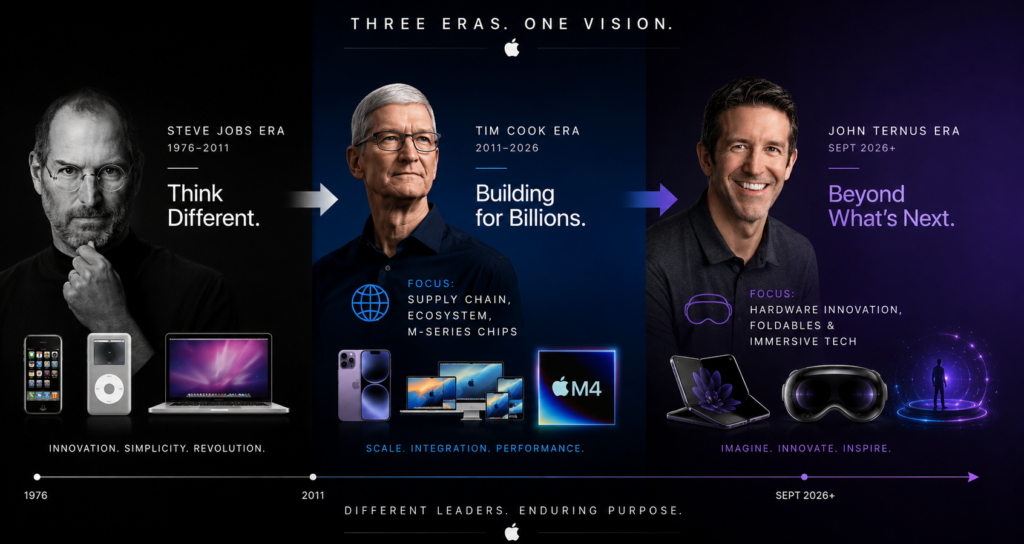
Ternus is a brilliant choice for Apple’s next phase. Having joined the product design team in 2001, he was the steady hand behind the transitions to Apple Silicon across the Mac lineup, the design of the iPad, and the engineering of the iPhone hardware ecosystem since 2020. His rise signals a new chapter focused heavily on hardware innovation built entirely around local AI processing.
The big keynote breakthroughs
Apple focused heavily on making devices vastly more responsive, private, and customizable this year. Here are the key software pillars from the event:
Siri becomes Siri AI
Rebuilt entirely on the next generation of Apple Intelligence and integrated with Google’s Gemini models, the new Siri AI features deep personal context and on-screen awareness.
- The Look: On iPhones with a Dynamic Island, a sleek new Siri animation populates that space while processing your requests.
- The App: A brand-new dedicated Siri chatbot app lets you revisit a continuous text and voice conversation history, generate images via Image Playground, or analyze files.
- Visual Intelligence: Swiping down from the middle of the screen pulls up an interface layer where Siri AI can look at what’s on your screen, like a festival schedule or a screenshot on a Mac, and instantly add the details to your calendar.
- The EU Catch: Due to regulatory delays surrounding the Digital Markets Act (DMA), Siri AI will not be available at launch in the EU on iOS, iPadOS, or watchOS, though it will be accessible on Mac and Vision Pro.
Under-the-hood performance ratios
Apple completely rebuilt the foundational search index powering Spotlight, Mail, and Photos to index files almost immediately. By modifying the CPU scheduler, Apple is also giving older devices, including the iPhone 11, a noticeable performance boost.
- App Launch Speeds: System apps launch up to 30% faster.
- Photo Processing: Gallery photos load up to 70% faster right after capture.
- AirDrop Infrastructure: File transfer over local wireless protocols is up to 80% faster.
Hyper-precise parental controls
As global governments intensify scrutiny of child safety, iOS 27 rolls out robust protections.
Mandatory for children under 13, the new child accounts feature Ask to Browse, which requires real-time parental permission before accessing unapproved websites in Safari. Communication safety tools also automatically intervene to block or blur gory and violent content in shared media.
At-a-glance: WWDC 2026 highlights table
| Platform / Feature | Core Upgrade | Why It Matters |
|---|---|---|
| Siri AI & Dedicated App | Google Gemini Integration | Adds onscreen awareness, cross-app actions, personal context, and a text/voice history hub. |
| macOS Golden Gate | Dropping Intel Architecture | Marks the official end of Intel Mac support, moving 100% to Apple Silicon acceleration. |
| Passwords App | Automated Security Fixes | Apple Intelligence automatically updates weak or compromised login credentials on websites for you. |
| Parental Controls | Ask to Browse & Safety Blurs | Blocks explicit/gory media automatically and streamlines category-specific app schedules. |
| Liquid Glass UI | Visual Opacity Slider | Addresses legibility complaints by letting users adjust transparency from clear to fully tinted. |
| Cross-Platform | iCloud Shared Albums | Introduces photo sharing with full-resolution asset support across Android and Windows devices. |
The developer ecosystem: Coding agents & local clusters
For the pro community, the announcements went much deeper than consumer software. Xcode 27 introduced built-in Coding Agents from Anthropic, Google, and OpenAI.
Using inline annotations, developers can point directly to a line of code to have agents execute parallel tasks, like translating an entire user interface into Spanish or Filipino via a String Catalogue within minutes. Additionally, the Core AI team introduced new PyTorch optimization packages. Combined with the Neural Accelerators on the M5 chip, matrix multiplication runs four times faster.
For massive deployment needs, Apple’s open-source JACCL library now leverages Thunderbolt 5 RDMA to link multiple Macs into a local compute cluster, enabling developers to run trillion-parameter models locally with zero cloud token costs.
Distilled
Ultimately, WWDC 2026 will be remembered as the definitive milestone where Apple successfully embedded advanced artificial intelligence directly into the system layer without compromising its trademark stance on user privacy.
As Tim Cook prepares to step aside, he leaves behind an ecosystem methodically prepared for the next decade. The transition to John Ternus ensures that this highly sophisticated software intelligence will be backed by the most powerful, hardware-optimized silicon on the planet.
The developer betas are active today, and if the early performance metrics hold up, our relationship with personal technology is about to become faster, safer, and infinitely smarter.