

Google Scholar: The Quiet Engine Behind Research Authority


Most people think Google shapes the web. But Google Scholar shapes what counts as knowledge. If the standard Google search engine is the world’s digital front door, Google Scholar is the restricted-access basement where the blueprints for reality are kept.
For tech professionals, developers, and researchers, Scholar isn’t just a search tool; it’s an invisible infrastructure. It’s the API for human progress. While the main-deck Google algorithm is busy fighting SEO spam and AI-generated “slop,” Scholar is quietly indexing the peer-reviewed backbone of modern civilization.
But how did a “side project” from two Google engineers become the ultimate arbiter of academic authority? And more importantly, why should the tech industry care?
The “under-the-hood” genius of Scholar
To understand Google Scholar, you have to stop thinking of it as a website and start thinking of it as a massive, graph-based database. Launched in 2004 by Alex Verstak and Anurag Acharya, the goal was simple:
make “the world’s problem-solving information” accessible.
Before Scholar, finding research was a nightmare of fragmented silos. You had to know which specific database (like JSTOR, IEEE Xplore, or PubMed) held the paper you needed. Scholar acted as the ultimate crawler, ignoring the “noise” of the commercial web and focusing exclusively on the signal of scholarly PDF headers, citation formats, and institutional repositories.
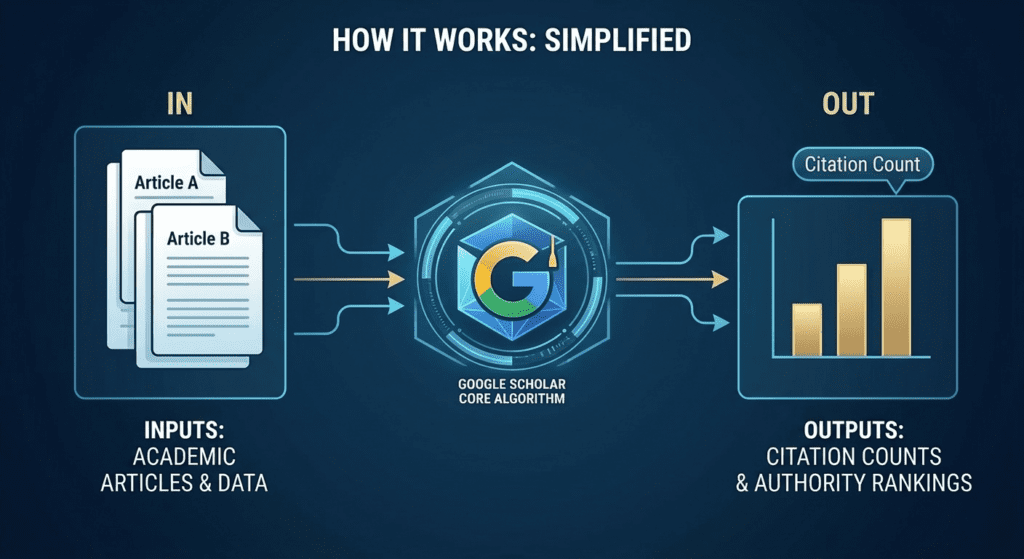
What makes it technically superior isn’t just the crawling, it’s the ranking algorithm. Standard Google uses PageRank (links from one site to another). Scholar uses a specialized version of this based on citation counts. If a paper is cited by 5,000 other papers, it’s deemed an “authoritative node.” This creates a self-reinforcing loop of knowledge where the most impactful ideas rise to the top of the stack.
The technical moat: How it indexes the “Invisible Web”
Standard web crawlers often struggle with “The Deep Web“—content hidden behind paywalls or complex database queries. Google Scholar solved this through technical partnerships.
- Metadata extraction: Scholar’s parsers are world-class. They can take a messy PDF and accurately extract the title, author list, and bibliography. This is a non-trivial NLP (Natural Language Processing) challenge, especially when dealing with various citation styles like APA, MLA, or BibTeX.
- The crawler-publisher handshake: Scholar worked with major academic publishers to allow its “Googlebot-Scholar” to index content behind paywalls. This ensures that even if you can’t read the full paper for free, you can find the existence of the knowledge.
- The versioning engine: One of its best technical features is the “All Versions” link. Scholar identifies that a pre-print on ArXiv, a PDF on a professor’s personal university page, and the final published version in Nature are all the same entity. This deduplication is essential for accurate citation tracking.
Why the tech industry lives and dies by the “Cite”
If you’re building a new LLM, optimizing a consensus algorithm for a blockchain, or designing a quantum-safe encryption protocol, you aren’t looking at blog posts. You’re looking at Scholar.
In the tech sector, Google Scholar is the primary tool for:
- Prior art searches: Before filing a patent, engineers use Scholar to see if someone else had the idea first.
- Vetting technical hype: When a new “breakthrough” happens in AI, tech leads go to Scholar to see if the paper has been peer-reviewed or if the methodology holds up to scrutiny.
- Identifying talent: Companies don’t just look at GitHub anymore. They look at Scholar profiles to find the PhDs who are actually pushing the boundaries of neural architecture or material science.
The ethics of the algorithm: The power to define “truth”
With great power comes a significant amount of “algorithmic bias.” Because Scholar prioritizes highly-cited papers, it can inadvertently create a “rich-get-richer” effect. New, groundbreaking research from a lesser-known university might struggle to outrank a 10-year-old paper from Stanford, simply because the older paper has had more time to accumulate citations.
Furthermore, the “Quiet Engine” is susceptible to Citation Gaming. We’ve seen “citation rings” where researchers agree to cite each other’s work to boost their rankings. For a tech publication, this is a fascinating look at how even the most “objective” academic tools are subject to the same vulnerabilities as social media algorithms.
The future: AI and the next evolution of scholar
As we move deeper into 2026, the intersection of LLMs and Google Scholar is where the real magic is happening. We are seeing a shift from “Keyword Search” to “Semantic Reasoning.”
Instead of searching for “latency in 6G networks,” users are beginning to ask, “Summarise the consensus on 6G latency challenges from papers published in the last 18 months.” Scholar’s structured data is the perfect training set for these high-fidelity AI models because it’s high-quality, verified data—the exact opposite of the “hallucination-prone” open web.
Distilled
Google Scholar is the ultimate proof that in the tech world, data is only as good as its organization. It has turned a chaotic sea of PDFs into a searchable, ranked, and authoritative map of human intelligence.
Next time you’re troubleshooting a complex system or researching a new tech stack, remember: the answer probably isn’t on a forum. It’s sitting in a peer-reviewed paper, indexed by the quietest, most powerful engine in Mountain View.