Marie Doce on Building Grounded AI Beyond the Tech Bubble


In conversation with Marie Doce, charting a new course with Grounded AI, rooted in place, purpose, and principle, after building at the heart of the generative AI surge.
After spending 15 years building inside venture-backed startups and enterprise AI companies, Marie Doce, Founder and Principal of Grounded AI, made a decision few leaders in tech do, she stepped away from the centre of the AI boom.
Instead of doubling down on scale and speed, she returned home to Humboldt County, California, and launched Grounded AI, a consulting practice designed to bring practical, ethical artificial intelligence to local businesses and community organisations.
In an industry dominated by investor narratives and platform power, Doce’s pivot represents something different: AI shaped by real-world constraints, community values, and deliberate choice.
In this conversation, she reflects on leaving the AI echo chamber, the lessons she carried from generative AI’s growth curve, and why the future of meaningful innovation may depend less on hype and more on grounding.
Grounded AI as a movement
What is Grounded AI, and why does the industry need something like this right now?
Marie: Grounded AI is an AI consulting practice based in Humboldt County, California, a rural community on California’s North Coast. We help local businesses and community organisations adopt AI practically and ethically, only where it genuinely adds value. That last part is key. A lot of what passes for AI adoption right now is adoption for its own sake, and the businesses paying the price are often the ones without the resources to determine what’s truly impactful and what isn’t.
The industry needs something like this because the loudest voices in AI are still the same: tech companies, investors, LinkedIn thought leaders, and early adopters in an echo chamber. That conversation has produced incredible technological advancements, but it hasn’t produced much wisdom about how that technology lands in the real world, in a small local accounting firm, legal practice, or nonprofit trying to serve its community with a two-person staff.
What I’m building is a bridge between the capability that exists and the context it needs to truly work. That means taking the time to understand a business before recommending any tool, teaching people when not to use AI just as much as when to use it, and doing that work face-to-face in a community I grew up in and genuinely care about.
Redefining AI leadership
What did you see inside the industry that convinced you the next wave of innovation needed to be more grounded and community-led?
Marie: I spent time at a Series A–funded generative AI startup from 2023–2024, a period of extraordinary momentum. The work was exciting, and I learned an enormous amount. But I also noticed something: the software I had built across multiple companies up to that point was used primarily by women, while features were often decided by predominantly male executives.
Product roadmaps were shaped by what would move the bottom line, not necessarily by what would meaningfully improve people’s lives. Critical decisions about technology were being made in rooms that didn’t include the people it was built for.
Then I moved back home, and the rural tech gap became impossible to ignore. Where I live, Google Maps is wrong half the time. Food delivery apps are limited. Cell service is unreliable, and apps designed around urban infrastructure simply don’t work here. These tools weren’t built by people from this community, and it shows.
That combination of what I’d seen inside the industry and what I was experiencing outside it made something clear: when companies are clustered in cities, the products they build reflect that geography. The communities left behind are a structural consequence of who gets to be in the room. Grounded AI exists to change that, at least in one place, starting here.
The moment that changed your lens
How did your experience with the Gemini team reshape your understanding of power, knowledge, and who AI should serve?
Marie: In 2023, while working at that AI startup, I was in regular partnership meetings with major LLM providers, including Google. When the Gemini team invited us to test an early version of their model, we ran it through our real marketing workflows: blog drafts, social content, product descriptions. It wasn’t ready for what we needed.
Then they asked for our exact prompts the methodology we had developed and refined over time. We declined. That was our intellectual property, and we treated it as such.
What struck me was what that request revealed. Here was one of the most well-resourced companies in the world, yet they still needed customers to understand whether their product worked in practice. Endless compute and talent and still a gap they couldn’t see from inside their own walls.
That asymmetry has shaped how I think about the AI industry ever since. The people generating the most useful insights are those using these tools in specific, high-stakes, real-world contexts, but they rarely have ownership over what gets built as a result. The knowledge flows up. The value stays at the top.
Now, when I work with a local business, I’m there to ensure the people closest to the problem have a say in how technology shows up in their lives. That’s the gap the industry still hasn’t closed and the one I find most worthwhile to work on.
Breaking the AI bubble
What does leadership look like when you step outside the tech echo chamber?
Marie: It looks a lot more like listening. Inside the ecosystem, there’s a shared vocabulary and set of assumptions about what matters and what’s next. Step outside of that, and those assumptions get tested constantly.
A managing partner at a local accounting firm isn’t thinking about foundation models or inference costs. She’s thinking about whether she can get home in time to pick up her kids, whether she can take on more clients this quarter, and whether the tools she’s already paying for are actually saving her time. Leadership in that context means meeting her where she is, not where the industry expects her to be.
It also means being comfortable saying, “I don’t know yet” and “Let’s figure it out together.” Trust in a small community is different. It’s personal, reputation-driven, and deeply local. That changes how you operate.
Responsible AI in practice
What safeguards are non-negotiable when working with local businesses and community organisations?
Marie: There are three things I won’t compromise on.
The first is informed consent around data. Before any AI tool touches a client’s workflow, they need to understand what data is being processed, where it goes, and who can access it. For professional services firms especially, that conversation is essential.
The second is human oversight on anything consequential. AI should accelerate human judgment, not replace it. That assumption is built into every engagement.
The third is an honest assessment of whether AI is the right tool at all. If a business’s real problem is staffing or communication, adding AI won’t fix it.
Part of what I stand for is discernment, using technology purposefully, not indiscriminately.
Grounded AI as infrastructure
How do you ensure AI becomes part of how businesses operate, not just another trend?
Marie: By starting with the workflow, not the product. Many businesses I work with are already using tools like ChatGPT or paying for software with AI features they don’t fully utilise. No one has taken the time to show them where AI actually fits into how they work.
That’s what turns a feature into a habit and a habit into infrastructure. When a team stops thinking about AI as something new and starts seeing it as part of how they operate, that’s when adoption truly happens.
I also think a lot about what I’d call “quiet ROI.” The accountant who saves hours a day doesn’t post about it on social media, but she tells her peers. That’s how adoption spreads in communities like this: through trust and real results.
Courage over conformity

What does it take to build serious AI work outside traditional tech hubs?
Marie: To be honest, that conviction came from being a mother. I moved back home with my one- and two-year-old children because I wanted them to grow up in a close-knit community, surrounded by nature.
Once I returned, I couldn’t ignore the gap. Businesses here were underserved by a tech industry that didn’t understand them. I had both the experience and the local roots and that felt like both an opportunity and a responsibility.
The conviction also comes from not needing external validation. When you’re building outside traditional ecosystems, you have to define success differently. For me, it’s the businesses I help and the relationships I build. That’s what makes the work meaningful.
Build vs buy
How do you guide teams through AI decisions?
Marie: I start by asking where they’re spending the most time. Often, it’s not a model problem; it’s a workflow or process problem. Most of the value comes from helping people use what they already have, but better.
When I recommend building or integrating, I look at repetition, output quality, and long-term maintainability. The goal is always simplicity. Solve at the simplest layer that works and build something the business will still be using a year from now.
Scaling impact, not headcount
What does success look like for Grounded AI?
Marie: Success looks like Humboldt County businesses becoming more capable and resilient, not dependent on me, but equipped with real skills and confidence.
In five years, I’d like Grounded AI to evolve into a platform, something other practitioners can build through, with case studies and frameworks that other communities can adopt.
More than anything, I’m tracking whether the community’s relationship with AI shifts from anxiety to informed agency. If people experience that shift firsthand, then the work has truly landed.
Leading on your own terms
What would you say to women building in AI today?
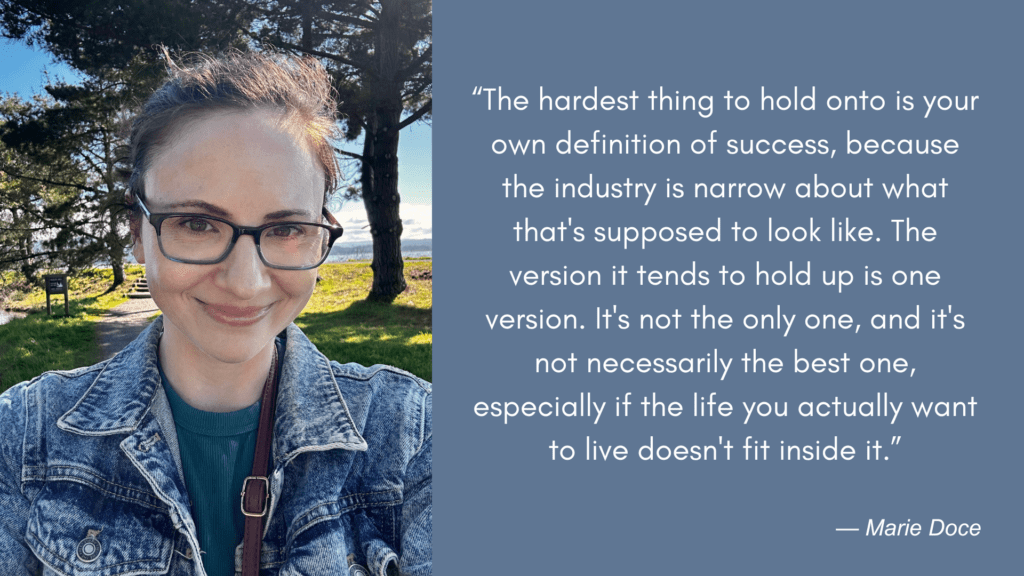
Marie: The hardest thing to hold onto is your own definition of success, because the industry is often narrow about what that’s supposed to look like. The version it tends to hold up is just one version. It’s not the only one, and it’s not necessarily the best one, especially if the life you actually want to live doesn’t fit inside it.
I built Grounded AI around constraints that might look limiting from the outside. Those constraints have actually made it more differentiated and more durable.
To women building something specific, rooted in a place, a problem, or a community, that specificity is your advantage. It’s something no one else can replicate. Build toward it, not away from it.