André Lucas Fernandes on Sustainable AI Infrastructure


Code, Climate, and Conscience: In conversation with the director of IP.rec (Law and Technology Research Institute of Recife), detailing how the tech industry’s pursuit of infinite scale is draining resources and displacing marginalized groups. He outlines the urgent need to bring civil society together to build sustainable AI infrastructure.
Tech for Tomorrow | A June Series on Sustainable Innovation
The rapid acceleration of artificial intelligence presents both an unprecedented technological leap and a profound environmental challenge. As the physical footprint of generative models expands, the future of innovation depends on harmonizing digital progress with planetary health. This June, Tech for Tomorrow hosts constructive conversations with the global leaders, legal architects, and sustainability pioneers who are actively solving this equation. Join us as we explore how these visionaries are rewriting the blueprint to build sustainable AI infrastructure, protect vulnerable ecosystems, and anchor our technological advancements in responsible, real-world solutions.
In the global race to build the smartest AI, we often forget that intelligence has a physical weight. It consumes water, devours energy, and leaves a footprint that no Cloud can truly hide. If tech is the engine of our future, our first guest in the Tech for Tomorrow series is the man who ensures the brakes and guardrails are in place for sustainable AI infrastructure.
André Lucas Fernandes isn’t your typical tech commentator. A PhD in Law and a foundational voice in the Vulnerability Principle, André sits at the high-stakes intersection of digital rights and environmental materiality. As the Director of IP.rec in Recife, he is moving the conversation beyond just bits and bytes and into the very soil and sea that power our digital world.
The origin & the environmental cost of AI
We talked to André about why the most responsible innovation and sustainable AI infrastructure of tomorrow aren’t just about better code; they’re about a healthier planet.
1. You have navigated the worlds of law, history, and high-level AI policy. What was the specific signal in your career that made you realize digital rights and environmental sustainability were actually two sides of the same coin?
André Lucas Fernandes: I have always admired Environmental Law as a field. My work as an academic who gets directly involved in citizen participation and public policy-making began with the right to the city, where environmental debates play a major role. So, the foundations were already there.
Throughout my research involving law, history, and AI policy, I began to realize how the broader project of technological development tends to ignore environmental concerns. In fact, technologists still often operate within the old and outdated triple helix model of innovation, which sidelines civil society and pushes the environmental dilemma to the margins of the debate.
Putting two and two together, it became clear to me that the environmental debate, especially the climate crisis, is fundamentally also a technology debate. The turning point came when I noticed how major companies were increasingly moving to secure more energy sources for data centers, even incorporating the construction of energy infrastructure into their own business models, often relying on non-renewable, unclean, and unsafe sources of energy.
2. The Philosophy of Enough: In a tech world obsessed with more (more data, more parameters, more compute), how do you personally define Responsible Innovation? Is it about doing more, or about doing better with less?
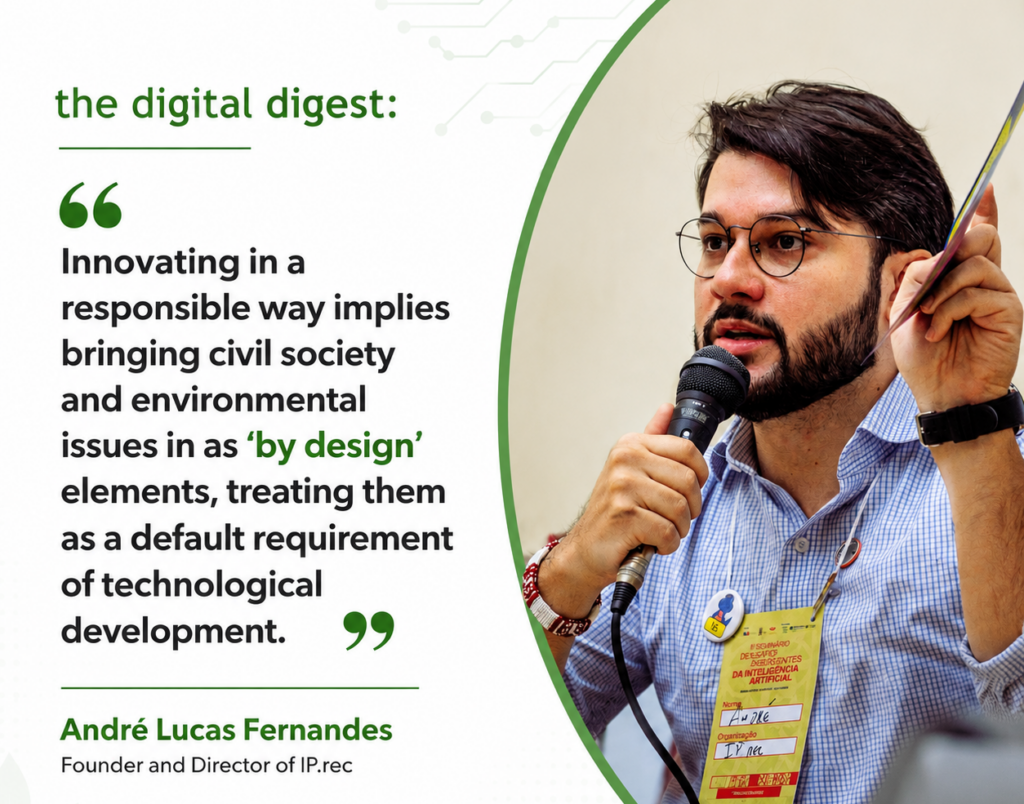
André: Responsible innovation stands in opposition to a predatory model of the planet, a logic of infinite scale that is embedded in the DNA of tech companies defending an agenda that is entirely non-social. Innovating in a responsible way implies bringing civil society and environmental issues in as by design elements, treating them as a default requirement of technological development.
If this is true, then models of ad infinitum scale become true contradictions. It is about doing better with less, not necessarily more. It is about understanding, in a sociotechnical way, what we really need.
“Today, what are large generative AI models that consume energy, water, and land actually used for? They are not announcing the cure for cancer every week, nor a solution to the environmental cataclysm. The tech gurus sell us promises, seasoned with speculation, myth-making, and imprecise or false information.”
3. The Recife Influence: You are deeply rooted in Recife, a city with a vibrant tech soul. How has the unique landscape of the Brazilian Silicon Valley shaped your perspective on building tech that respects both the community and the climate?
André: Recife is a regional innovation hub in Brazil that suffers from intense contradictions. One of them is trying to emulate Silicon Valley within our own reality. Our Porto Digital project influenced me first through admiration, and then through rejection.
The Porto Digital project is admirable; it mobilizes a highly relevant economy for the city and the country. However, it mimics terms, ideas, and realities that are not ours. In doing so, it ignores the true meaning of innovation that emerges bottom-up from the territory. This ecosystem plays an important role in revitalizing downtown Recife. The oldest capital in Brazil, but it is also responsible for a process of homogenization. It brings gentrification, rising living costs, and the displacement of mixed-use and residential spaces. It creates a critical scenario. Where vulnerable people live on the streets while startups make thousands of reais. And a millionaire microeconomic system moves around them.
Furthermore, Recife is among the world’s most threatened cities by sea-level rise. It could disappear in the form we know it today within the next 100 years. My perspective is a pain born from living these contradictions, but also from aspiring to realize our potential to do things differently.
The law and green data center infrastructure
4. The Materiality of AI: At IP.rec, you’ve focused on the materiality of the internet. For someone who thinks of the web as invisible, how do you explain the very physical, heavy footprint of a large language model?
André: It is vital to point out to those who still believe in the cloud that it is purely a metaphor used for marketing purposes. From a linguistic point of view, it explains very little. It creates a false notion that data is just floating in the air, suspended and weightless. This marketing helped consolidate a false idea that Information and Communications Technologies (ICTs) are ethereal. Leaving no concrete trace in the physical world. The problem is that this is obviously untrue.
There is no internet connection without cables crossing the entire planet across five continents. Just as there is no cloud, there are only computers. Or rather, massive industrial data centers storing and processing data 24 hours a day. If your laptop heats up and sounds like it’s about to take off when running heavy tasks, imagine the industrial-scale apparatus required to sustain global AI.
That is the footprint of Large Language Models (LLMs). They are among the computational systems with the highest processing demands in history. In terms of physical hardware, we are literally talking about frying devices.
5. The Transparency Guardrails: You’ve worked on AI governance-as-code. How can we legally ensure that Greener Infrastructure isn’t just a marketing term, but a verifiable, technical reality for data centers?
André: We must abandon the myth of self-regulation. The market will not address this issue on its own. Lobbying groups around the world are actively defending a model of infinite scale, completely ignoring that the world is finite. Regulation is a necessity. The real question is what that regulation should look like.
We must start with transparency. Today, the data center economy is built entirely on NDAs and deliberate opacity. You cannot build meaningful public participation without transparency. Data must be analyzed, methodologies scrutinized, and collective conclusions reached by both science and society.
But we cannot stop at disclosure alone. We need a strong regulatory body to enforce strict metrics for energy costs and water usage. Alongside the control of chemical, light, and noise pollution. In the case of Brazil, regulation must also act as an incentive for technology transfer and a barrier against tech-subordination and recolonization. Where the Global South concentrates the environmental damage while the profits are transferred abroad.
Finally, regulation must respect local territories. As we say in Brazil, two wrongs don’t make a right. Data centers, like any other high-impact industry, must involve prior, free, and informed consultation with local communities. People must have the right to accept, oppose, or demand strong compensation. So that this infrastructure serves to develop society, rather than just boosting a tech company’s valuation.
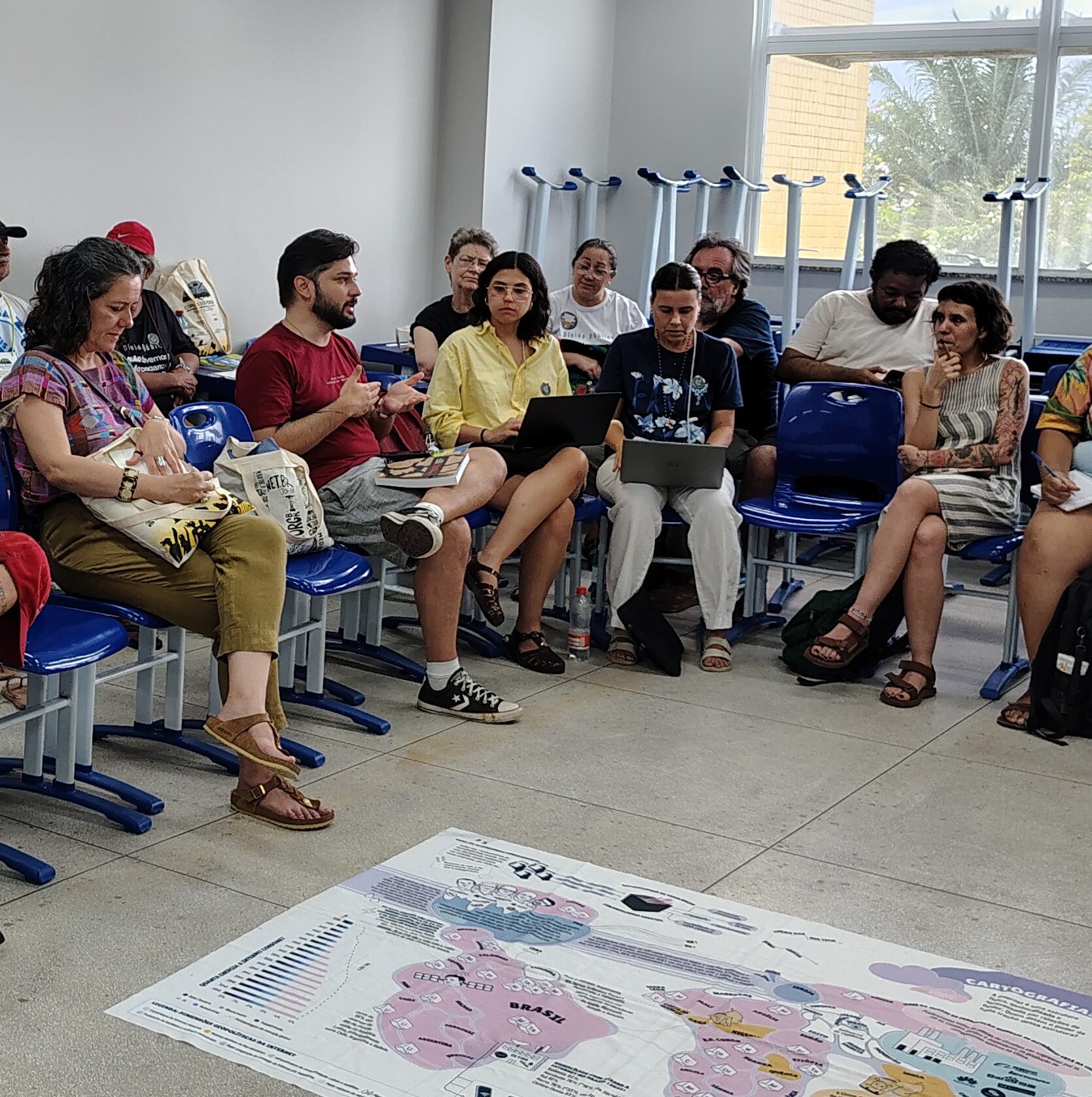
André Lucas Fernandes participating in a community consultation and territorial mapping exercise.
6. The Vulnerability Principle: You often speak about protecting the vulnerable. In the context of Tech for Tomorrow, how does failing to build sustainable AI infrastructure create new risks for marginalized communities?
André: The lack of protection for affected communities, especially marginalized groups, is unfortunately a hallmark of large technological projects. This manifests not just in algorithmic biases but in the physical expropriation of a territory’s natural resources.
For these communities, a lack of tech sustainability carries a heavy burden of exclusion, displacement, and the reinforcement of systemic inequalities. For them, environmental neglect is not a matter of indifference. It is a direct form of structural violence, led by the private tech sector in close partnership with elected public officials.
7. Digital Rights as Energy Rights: Do you believe that Digital Citizenship in 2026 should include a fundamental right to know the carbon and water cost of the AI tools we interact with daily?
André: Yes. It is no longer possible to discuss the digital space without intersecting it with energy, the decarbonization of the economy and the collective management of how we inhabit this planet. It seems we have learned nothing from history or cautionary tales. Tech gurus treat dystopian warnings not as alerts, but as inspiration.
The deep dive into sustainable AI infrastructure
8. The Incentive Problem: Right now, speed often beats sustainability in the AI race. From a legal standpoint, how do we flip the script so that building sustainable AI infrastructure becomes the most profitable path for innovation?
André: The State has an essential role to play here, especially in the absence of a corporate moral conscience. Private tech actors fail to realize that when you live on an exhausted planet, scaling infinitely implies a form of catalysis; you are destroying the very environment that sustains you. However, the State itself must remain under civil society’s oversight and open to scientific scrutiny to stay updated.
In Brazil, when policymakers attempted to incorporate environmental obligations to encourage green data centers, they created a regulatory monster called REDATA. Though not yet in force, it unfortunately reintroduces a dynamic of resource extraction. Heavy tax exemptions at the cost of social development, and the socialization of environmental risks. The profits remain concentrated in a few hands.
But the moral paradigm is shifting. Every day, more grassroots movements are emerging. To demand higher environmental standards for data centers, we are seeing this clearly in the US. This democratic momentum is central. It combines scientific data, a demand for transparency, and a collective pursuit of the good life. We are turning a key in society’s perception of what matters. Under this new paradigm, current predatory business models will become untenable because they are heading straight toward an abyss. Traditional market logic is incapable of creating these sustainability incentives on its own. We must bring democratic and environmental perspectives together.
9. The Data Center Paradox: Brazil has an incredible opportunity to lead in green data hosting. What is the biggest hurdle preventing us from becoming the global blueprint for Circular Tech Infrastructure?
André: The core problem is that policies like REDATA treat the environment as a secondary, merely symbolic concern. The entire legislative framework focuses heavily on tax exemptions rather than ensuring real environmental countermeasures.
Look at the cases of Caucaia in Ceará, or Eldorado do Sul in Rio Grande do Sul. Both territories face catastrophic environmental vulnerabilities and house marginalized populations. Yet, they were not consulted. Creating a familiar recipe where regions are turned into sacrifice zones to enable massive data centers. This is not green.
Brazil presents itself at COP 30 as an environmental champion with a flashy roadmap. But internally, it acts with a blind, despotic developmentalism that undermines safeguards. In the current hyper-scale AI race, Brazil will not even cross the finish line, let alone win. The true path forward lies in thinking about innovation through a complex, situated lens. Investing in federated processing and abolishing the logic of infinite scale.
We need models engineered for efficiency and lower energy consumption. Such as Small Language Models (SLMs) to solve real problems without succumbing to the egocentric, bizarre myth of pursuing Artificial General Intelligence (AGI).
10. The Role of the Lawyer: As a PhD in Law and AI, do you see the guardrails for sustainable AI infrastructure as strictly technical, or do we need a new generation of “Eco-Legal” thinkers to bridge the gap between code and climate?
André: This debate is entirely interdisciplinary. We frequently observe that technology faculties hardly address ethics within their syllabi.
Ethics belongs to philosophy, but it takes its practical, enforceable form in Law. Only when interdisciplinary professionals from all fields move toward a common ground will we bridge this gap. Those of us in law have something vital to contribute. Regarding the power to stop, reflect, protect, and de-escalate investments that do not focus on the collective good. Even with all its evident flaws, the law remains a field capable of generating positive averages for human life.
The future of sustainable tech and society
11. If we succeed in our Tech for Tomorrow goals, what is one thing about our relationship with technology that will be unrecognizable 20 years from now?
André: We will have completely disavowed technosolutionist delusions. In 20 years, we may finally realize that technology does not fall from the sky. It cannot exist without physical costs and consequences.
Success will look like a complete rejection of infinite scale and ideologically driven tech projects like the pursuit of General AI or delirious concepts like the singularity. All of that will be relegated to ridicule. In its place, we will have technology oriented toward societal reality. Serving as a foundation for those who are hungry, those suffering from systemic diseases, and those marginalized by systems of exclusion.
12. The Personal North Star: Outside of the institutional goals of IP.rec and the world of academia, what is the one personal project or vision that you are most excited to bring to life this year?
André: This year, I want to catalyze networks that actively break the colonial logics afflicting my country and reproducing themselves internally.But on a deeply personal level, I want to reject the black hole of the infodemic that constantly overwhelms and disturbs us. I want to go back to doing something that has always made me feel whole, feeling the pure physical flow after a long swimming workout, where you temporarily lose your memory. I also want to return to writing poetry; my teenage self misses expressing other ways of knowing and feeling.
Ultimately, it’s about making sure that, even with everything we are living through, work fits into life, and not the other way around.
About the Speaker
André Lucas Fernandes is a leading legal architect in the field of Artificial Intelligence and the Founder and Director of IP.rec (the Law and Technology Research Institute of Recife). A PhD in Law with a focus on the history of legal concepts and innovation, André has become a pivotal voice in defining the “Vulnerability Principle” in AI governance. His work spans from the Brazilian Bar Association to the Center for AI and Digital Policy (CAIDP), where he advocates for a future where tech is regulated not just for algorithmic safety, but for its physical and environmental impact. Based in the tech-forward hub of Recife, André bridges the gap between high-level legal theory and the tangible, material reality of our digital world.
This is Part 1 of our June Series on Sustainable Innovation. Check back next week as we dive into the hardware cooling breakthroughs powering the next generation of sustainable AI infrastructure.