
John Ternus Named CEO of Apple: Dawn of Engineering Era


On April 20, 2026, Apple officially confirmed that John Ternus, the Senior Vice President of Hardware Engineering, will become the company’s next CEO on September 1, 2026. After a historic 15-year tenure, Tim Cook will transition to the role of Executive Chairman.
This appointment is a strategic homecoming for the world’s first $4 trillion company. While Tim Cook was the operational titan who scaled Apple into a global juggernaut, Ternus, a 25-year veteran of the company, is an Engineer’s Engineer.
His leadership signals a shift back toward hardware-led innovation as the primary driver for Apple’s next decade.
The rise of the next CEO
John Ternus, 50, is a quintessential Apple lifer. He joined the company in 2001, the same year the original iPod was launched, and has spent nearly his entire professional life within the walls of Infinite Loop and Apple Park. A mechanical engineer by training, his rise was methodical and tied to Apple’s most successful modern hardware pivots.
By 2013, Ternus was leading the engineering teams for the Mac, iPad, and AirPods. By 2021, he was elevated to Senior Vice President of Hardware Engineering. Crucially, by the time of his CEO appointment, Ternus already oversaw the development of products responsible for roughly 80% of Apple’s revenue.
Unlike the more reserved Cook, Ternus is widely regarded as charismatic and well-liked. Known for working alongside his teams in open office environments rather than secluded executive suites. Current and former employees credit him with reversing a trend of declining product quality. Specifically by pushing for utility and performance over the thin-at-all-cost minimalism of the mid-2010s.
The evolution of Apple leadership: A 40-year timeline
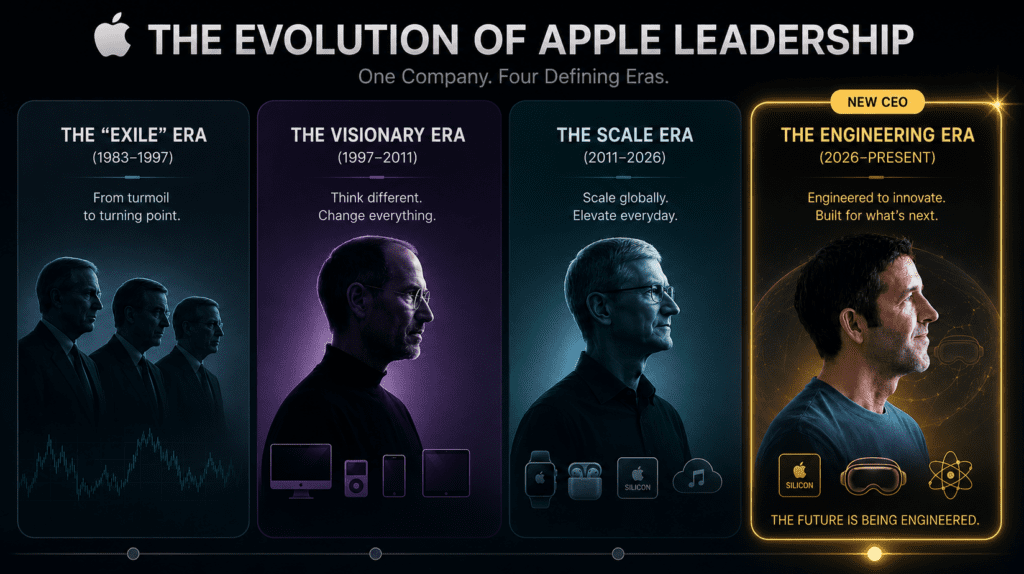
To understand why Ternus is the right choice for 2026, we must look at the distinct eras defined by those who came before him. Since the early 1980s, Apple has moved through periods of crisis, creation, and massive expansion.
| Era | Leader(s) | Key Philosophy | Defining Impact |
|---|---|---|---|
| The “Exile” Era (1983–1997) | John Sculley, Michael Spindler, Gil Amelio | Corporate Management: A period of rapid growth followed by an intense financial crisis and failed merger talks. | Oversaw the launch of the PowerBook, but nearly led the company to bankruptcy before Amelio bought NeXT to bring back Jobs. |
| The Visionary Era (1997–2011) | Steve Jobs | The Architect: Focused on radical product simplification and high-stakes “visionary” bets. | Saved Apple from insolvency; launched the iMac, iPod, iPhone, and iPad. |
| The Scale Era (2011–2026) | Tim Cook | The Mastermind: Focused on supply chain efficiency, ecosystem expansion, and high-margin services. | Grew Apple to a $4T valuation; oversaw the transition to Apple Silicon and the launch of the Apple Watch and AirPods. |
| The Engineering Era (2026–Present) | John Ternus | The Purist: A focus on hardware-software synergy, technical depth, and silicon-first design. | Tasked with leading the post-iPhone era, including spatial computing and “Apple Intelligence.” |
The Tim Cook legacy: The four-trillion-dollar fortress
Tim Cook’s tenure will be remembered for its unprecedented operational success. When Cook took over in 2011, Apple was a successful hardware company; when he stepped down in 2026, it was a global utility.
- Financial explosion: Under Cook, Apple’s valuation surged from $350 billion to $4 trillion, and annual revenue crossed $416 billion by 2025, according to Forbes.
- The services pivot: Cook realized that hardware sales would eventually hit a ceiling. He built a services empire, iCloud, Apple Music, Pay, and TV+, that now generates over $100 billion in annual revenue.
- The silicon revolution: Perhaps Cook’s most significant engineering victory was the transition to custom M-series chips. This project, which Ternus personally helped execute, decoupled Apple’s innovation cycle from third-party vendors and redefined Mac performance.
How Ternus will be different
While Tim Cook came from a background of “Industrial Engineering” and global logistics, Ternus is a Product Designer at his core. This DNA shift will manifest in three key ways:
A return to ‘product-first‘
Ternus is famously the executive who listened to the Pro community. He oversaw the removal of the controversial butterfly keyboard and the reintroduction of essential ports to the MacBook Pro. As CEO, he is expected to be more hands-on with the R&D process, prioritizing functional excellence and the “tactile” experience of the hardware.
Hardware-driven AI
In 2026, the technology landscape is dominated by generative AI. While competitors focus on the cloud, Ternus’ background suggests Apple will double down on On-Device AI. His leadership will likely center on building custom NPUs (Neural Processing Units) that keep “Apple Intelligence” private, fast, and local.
Cross-functional synergy
Ternus has shown a knack for strategic ambition beyond his hardware silo. He was instrumental in pushing for iPadOS, recognizing that the hardware was being stifled by phone-based software. In the Ternus era, we can expect the lines between hardware, software, and silicon departments to blur even further.
Distilled
The appointment of John Ternus as Apple CEO is a signal that Apple is ready to move past its Efficiency Era” and return to its Engineering Era.
The company has already mastered the supply chain and built a massive services moat. What it needs now is a leader who understands why a device feels the way it does and how a custom chip can achieve things no one else can.
If Steve Jobs infused Apple with its soul and Tim Cook expanded its scale, John Ternus has now been tasked with providing the substance for the next decade. The transition on September 1, 2026, marks the end of the greatest operational run in corporate history and the beginning of a new chapter in which the hardware and the engineers who build it are once again the stars of the show.