
What Breaks First in AI Catalog Management Without Control


After the first wave of excitement around AI as a broad transformation in e-commerce, the conversation has become more grounded. Teams are now focusing on the work they’ve long tried to accelerate: filling gaps in product data, improving content quality, reducing manual effort, and moving records through systems more efficiently.
Catalog operations sit directly at that intersection of scale, inconsistency, and operational drag, making them an obvious candidate for AI. At that point, many teams make a reasonable assumption: that the first problems with AI will show up in the content itself: hallucinations, generic copy, or language that doesn’t align with the brand.
Those risks are real. But in practice, they’re rarely the first thing to break. What tends to fail earlier is control: the logic around review, approval, exceptions, and the basic ability to trust how changes move through the catalog once AI enters the flow.
That’s usually where initial enthusiasm starts to fade.
The more useful question, then, is not whether AI can generate usable content, but why it becomes difficult to use within real catalog operations before content quality even becomes the primary issue.
Why the catalog process looks ready for AI
In many e-commerce teams, the catalog workflow follows a familiar path. Supplier data comes in, and the team prepares it for publishing: fields are cleaned up, gaps are filled, the structure is aligned, and the record is brought closer to what the site can use.
In most e-commerce organizations, catalog workflows follow a familiar path. Supplier data comes in, and teams prepare it for publishing: cleaning fields, filling gaps, aligning structure, and shaping records into something usable.
This is exactly where AI appears to fit naturally.
If it can generate product content on top of that process, it seems logical to let it accelerate work already being done.
A typical case looks straightforward: a supplier record arrives incomplete, with missing attributes, inconsistent values, and a minimal description. Previously, teams would manually fill those gaps, relying on their understanding of recurring issues in supplier data.
With AI in place, that same record moves differently. The output may sound complete, even when the underlying record is not. Missing fields remain missing. Conflicts remain unresolved. But the language now masks those gaps instead of exposing them.
That’s where the problem begins.
Because the bottleneck in catalog operations is rarely text alone.Supplier input does not become a publish-ready product record by itself. There is still critical operational work in between: normalizing attributes, resolving contradictions, validating completeness, preserving manual corrections, and aligning content with structured data.
In many organizations, work still depends on a mix of manual review, implicit rules, spreadsheets, and accumulated team judgment.
So when AI is introduced as a fast generation layer before control logic is clearly defined, the system starts producing changes faster than the organization can reliably validate, route, or absorb.
Where AI catalog management fails without governance
Once AI begins influencing catalog flow before the rules around review, approval, and exceptions are clearly defined, the weak points usually show up in a few very specific places.
- Content starts saying more than the record can support. A title, bullet set, or description may look cleaner and more complete, while the product record underneath is still missing fields, contains conflicting values, or has not been fully checked. The risk is that the card starts presenting the product with more certainty than the underlying data can actually justify.
- No one has defined what is ready to publish. AI can generate output, but the process still needs clear logic for what can go live automatically, what should be reviewed, and what must be held back. Without that distinction, teams end up treating too many records as special cases.
- Manual corrections and automated changes stop working together. Editors adjust records because they understand where supplier input is weak, incomplete, or misleading. If AI suggestions are applied separately from that work, those corrections can be overwritten, duplicated, or quietly disconnected from later updates.
- Uncertain cases have nowhere to go. Conflicting attributes, low-confidence suggestions, regional constraints, and category-specific exceptions do not disappear when AI is added. But without a defined review path, they accumulate as hidden operational work rather than becoming part of a managed process.
Taken separately, these may seem manageable. What they usually point to, though, is a more structural problem: instead of helping create content, AI is beginning to shape how catalog changes move through the business, while the control model around those changes is still too weak or too implicit to support that shift.
What the governed AI approach requires
The shift happens when AI stops being a content tool and starts influencing workflow: which records move forward, which are reviewed, and which changes are applied or held back. At that point, the question is no longer whether AI can generate content. It’s about what operating model is required when AI begins shaping the flow of catalog operations.
A few principles become essential:
Structured attributes must come before content.
Text should not become the source of truth. It should be generated from attributes that are already extracted, normalized, and validated. Otherwise, language ends up compensating for unstable data.
Automation must be confidence-based.
Not all changes are equal. Some can be safely automated; others cannot. Without that distinction, scale quickly becomes unmanageable.
Human review must be built into the flow.
Not as a generic approval step, but as a meaningful stage where reviewers can see what changed, how confident the system is, and what supports the suggestion. AI should remove routine work—not eliminate judgment.
Changes should move through drafts, diffs, and versions.
Rather than direct overwrites, this approach preserves visibility and reversibility. It ensures the organization retains control over what is proposed, approved, and applied.
Manual edits must be explicitly preserved.
If catalog records evolve through a mix of source data, rules, and AI outputs, the system needs to recognize and protect human-set values from being overwritten without review.
One practical way to implement this is by introducing an operational AI layer between raw data sources and the PIM. That is the logic behind solutions such as Catalog AI Studio. Not just another generation tool, but a governed layer that enriches attributes, routes uncertain cases, generates content from validated data, and manages changes through controlled workflows.
The value of this approach is not that AI can produce content. It’s that content is produced within a system that keeps the catalog controlled as changes move through it.
Usable AI depends on control
This is not simply about being more cautious with AI. Caution alone does not solve the problem. AI becomes useful in catalog operations only when it operates within a system that can decide:
- What should move automatically
- What requires human judgment
- What is not ready to move forward
That is a fundamentally different standard from simply asking whether the output is usable. In real catalog environments, product data quality, content accuracy, operational speed, and trust in the process must hold together.
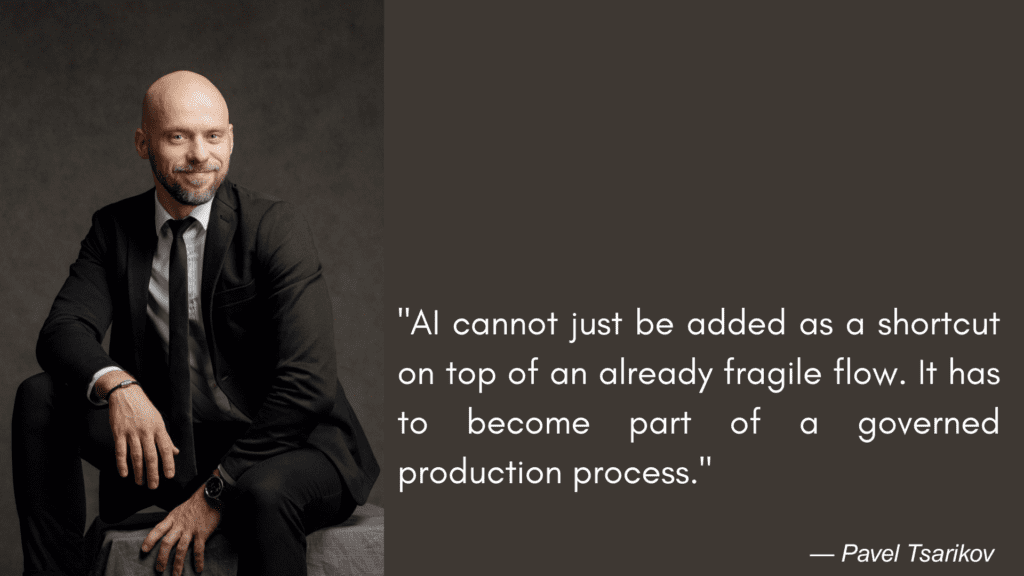
AI cannot be layered onto a fragile workflow as a shortcut.
It has to become part of a governed production system, one that can absorb automation without losing control over how changes are reviewed, applied, and trusted.
Distilled
AI doesn’t break ecommerce catalogs through bad content first; it breaks them through loss of control. Without clear governance, review logic, and workflow structure, AI accelerates changes faster than teams can validate or trust.
Digital Digest publishes perspectives from industry practitioners across technology, operations, and strategy. These contributed articles reflect the author’s experience and are part of our effort to bring diverse, practitioner-led insights to our audience.