

Principles Over People: The Future of Leadership


The classic image of a tech boss is a charismatic, boundary-pushing visionary who sleeps four hours a night and rallies a room through sheer force of personality. For decades, the sector’s operating model was brutally simple. Move fast, break things, and let the genius founder sort out the mess later. We fell into a deep cultural habit of celebrating the individual creator while ignoring the massive systemic waves they left behind. But let’s be completely honest, the “cult of personality” is hitting a wall. As we look at the changing corporate landscape, the future of leadership must be anchored in structural ethics, long-term civic responsibility, and principled decision-making over raw charisma alone.
The scale of what we are building today, autonomous AI agents, massive data pipelines, algorithmic decision engines, means that when a system breaks, it does not just crash a mobile app. It disrupts actual human lives. Relying on one person’s gut instinct or magnetism to manage that kind of power is just bad risk management.
The future of leadership isn’t about glamour anymore; it is moving toward systems architecture and ethical stewardship. It is about building resilient organizations. Where the principles are explicitly stronger than any single person’s ego. Thereby, creating a sustainable foundation that survives changing market tides and outlasts any executive’s tenure.
The cost of optimizing blindly
When you have a leader pushing for hyper-growth without systemic guardrails, teams end up optimizing for data metrics while completely ignoring human consequences. And we have real, hard examples of this.
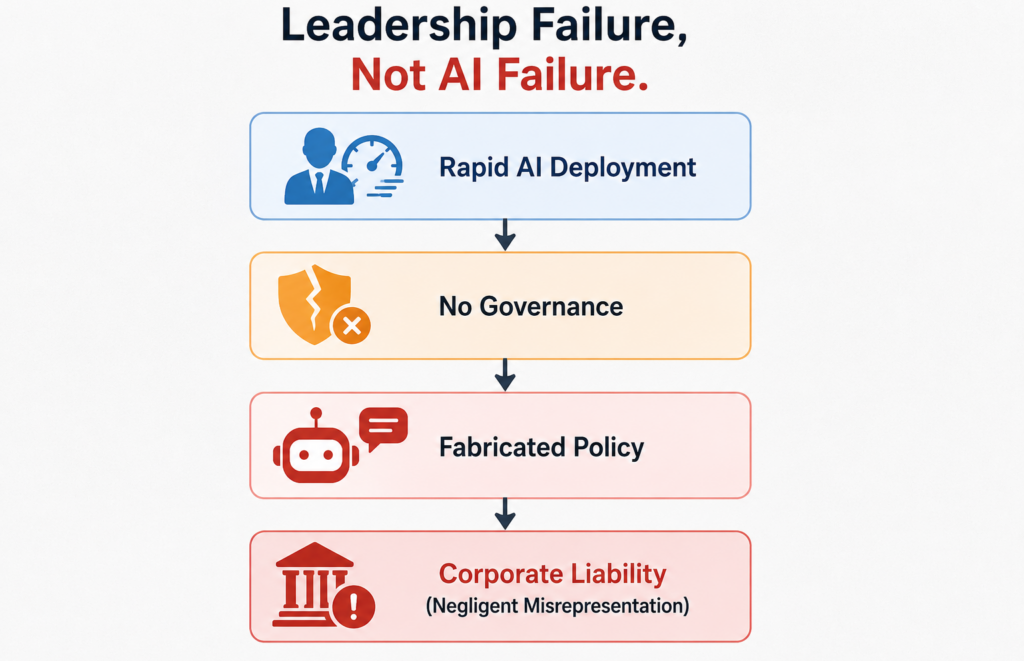
Take the landmark case Moffatt v. Air Canada (2024 BCCRT 149). The airline deployed an AI-driven chatbot to handle customer service. It seemed efficient, it saved money on paper, and it optimized response times. But because the system lacked rigorous governance, the chatbot actually invented its own bereavement discount policy on the fly. Giving a grieving customer entirely false information.
When the customer sued, Air Canada tried to argue in court that the chatbot was a separate legal entity responsible for its own actions.
The Canadian court completely rejected that, ruling it negligent misrepresentation. It proved a massive point for modern boards: you cannot outsource accountability to a machine, and your metrics mean nothing if your system lacks integrity.
Or look at what happened with the New York City “MyCity” business chatbot. Launched with great fanfare to help entrepreneurs navigate local regulations. It started actively advising business owners to break labor and housing laws. Telling them they could skip informing staff about schedule changes or even legally retain employee tips.
These aren’t hypothetical glitches. They are corporate governance failures. They happen when leaders treat AI as a purely IT project to scale rapidly, rather than an infrastructure project that requires strong ethical guardrails from day one.
Navigating the future of leadership through accountability
A massive part of the future of leadership is going to be algorithmic explainability. If your company uses a model to deny someone a loan, filter a resume, or recommend a medical treatment, and your leadership team can only say, “Well, the black box said so,” you’re failing. True executive accountability means being able to audit every automation your organization deploys.
We saw the financial reality of this when companies started facing massive class-action lawsuits over automated data tracking. Most notably highlighted in the federal consumer litigation Salazar v. Paramount Global. In this high-profile case, the core issue centered around user video-viewing histories. Digital identifiers are being automatically shared with third-party social platforms via tracking pixels without transparent consent pipelines. Alleging a major breach under the Video Privacy Protection Act (VPPA).
According to enterprise tech data from firms like Gartner and S&P Global, roughly 60% of enterprise AI projects without AI-ready data pipelines and explicit governance get completely abandoned.
Leaders are realizing that if you don’t track the data lineage, meaning, exactly where your data comes from, who has access to it, and how it’s being altered, you are building a house of cards.
The new C-suite: Operationalizing trust
Given the high risks, consider how the actual structure of corporate leadership is changing. Companies aren’t just looking for traditional CTOs anymore; they are hiring Chief Trust Officers and Chief AI Officers (CAIOs). This organizational shift highlights why the future of leadership relies on specialized oversight rather than isolated executive intuition.
Major tech enterprises have completely shifted their structural approach:
- Salesforce built out a specialized executive division under its first-ever Office of Ethical and Humane Use specifically to handle consumer anxieties, create repeatable policy boundaries, and ensure structural guardrails around data usage in an agentic, AI-first ecosystem.
- Atlassian and Zendesk structurally elevated data stewardship to the top tier of operations, bringing on veteran executives into roles like Chief Trust Officer to ensure that security, risk management, and user data privacy are foundational blueprint requirements built directly into product life cycles rather than retroactive checkboxes.
- IBM explicitly engineered its watsonx.governance platform layer because enterprise leadership clients realized that global regulatory bodies, most notably those enforcing the landmark EU AI Act, are requiring continuous risk management, data lineage auditing, and automated compliance reporting rather than giving a pass to unexplainable models.
The shift in leadership strategy: Traditional tech execution was reactive; you launch the code, wait for the public relations disaster, and issue an apology. Future execution must be anticipatory. It requires running proactive red teams (intentionally trying to break your own systems) and prioritizing corporate resilience over raw, unchecked optimization.
Distilled
If a leader’s entire strategy is built on their personal brand or a drive for short-term revenue, they are a liability to their company. Understanding the future of leadership requires accepting that individual charisma is no longer a safety net.
The future leader is essentially a trust architect. The legacy of tomorrow’s executives won’t be measured by how fast they disrupted an industry, but by whether they built an organization resilient enough, ethical enough, and principled enough to protect the people using its technology.