
AI Surveillance: Are Your Devices Spying on You?


Connected devices operate continuously in the background. They detect voice commands, track motion, and adapt to evolving usage habits. Although the phrase AI surveillance carries strong connotations, most device activity focuses on service optimisation. Data analysis supports recommendations, feature personalisation, and performance improvements rather than covert monitoring.
Are they really spying?
In most cases, no. Devices typically use low-power processing to detect triggers, such as wake words, before activating fuller systems. However, they do collect behavioural data and usage signals that support personalisation and analytics. The real concern is not hidden microphones recording everything. It is whether data collection is clearly explained and proportionate. Transparency, storage limits, and user control matter more than suspicion. Understanding what “always-on” means in practice helps separate myth from mechanism.
Let’s break it down, device by device.
What AI surveillance really means in everyday devices
AI surveillance does not always mean constant recording. Most modern devices rely on small, always-on sensors. These sensors wait for triggers such as a wake word, a movement pattern, or a behavioural signal. The AI inside them performs two main tasks. It listens or monitors lightly in the background. Then it activates more powerful processing when required.
Many companies now use on-device AI processing for simple tasks. That means data stays local unless a command requires cloud support. However, behavioural analytics and metadata often still travel to central servers. That gap between perception and reality is where trust weakens.
The smartphone in your pocket
Your smartphone is the most sophisticated always-on device you own.
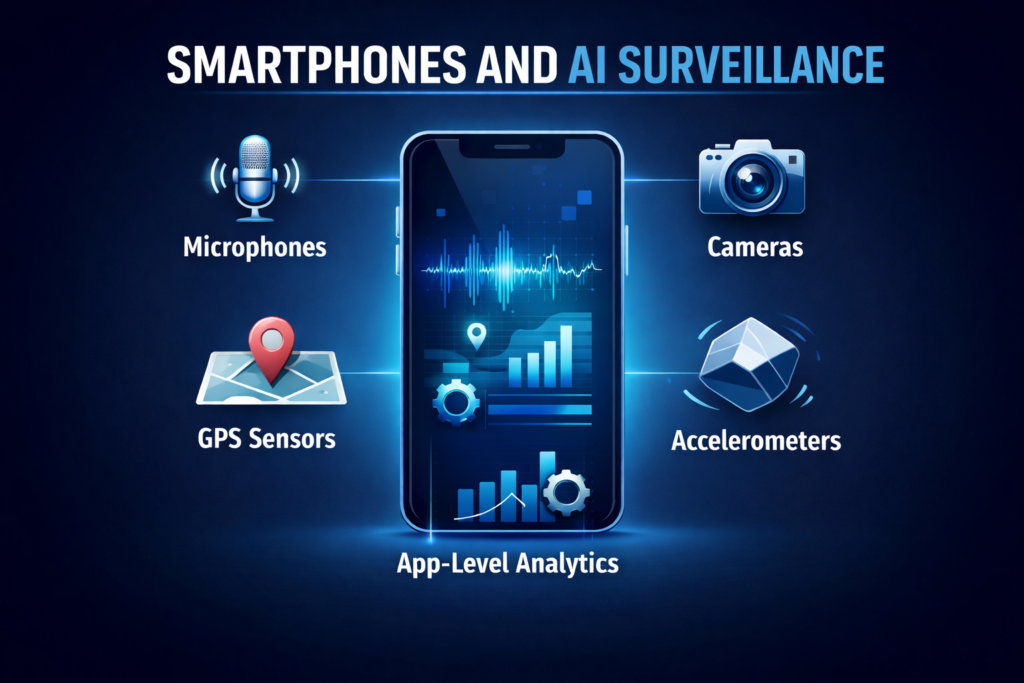
Phones are not constantly recording conversations. Instead, they use low-power chips to detect wake words locally. Only triggered commands usually move to the cloud. However, apps collect usage data continuously. They monitor location patterns, browsing behaviour, and in-app activity. Even metadata such as time stamps and device identifiers can build detailed profiles.
Predictive text also uses machine learning to learn how you write. Recommendation engines learn what you watch and read. Rather than cinematic espionage, the phone observes patterns to improve services and refine personalisation.
Brands prioritising stronger privacy controls
Some manufacturers embed stronger safeguards:
Subscribe to our bi-weekly newsletter
Get the latest trends, insights, and strategies delivered straight to your inbox.
- Apple emphasises on-device processing for Siri and uses App Tracking Transparency controls.
- Google Pixel devices include privacy dashboards that show which apps access sensors.
- Samsung integrates hardware-level protections through Knox security.
None eliminates data collection entirely. But some invest more heavily in Privacy by Design AI principles.
The smart speaker in your home
Smart speakers raise the most suspicion because they include microphones in shared spaces. Devices like Amazon Alexa and Google Nest use local wake word detection. They store short audio buffers temporarily. When triggered, they send recordings to cloud servers for interpretation.
False activations happen. A background phrase can trigger recording unintentionally. These recordings may be stored unless users disable voice history. In past years, reports revealed that anonymised clips were reviewed by human contractors for quality control. That discovery damaged public trust. The underlying problem was less about continuous recording and more about limited transparency.
Brands investing in privacy-focused features
- Apple HomePod processes more Siri requests on-device in newer models.
- Amazon Alexa allows manual deletion of voice history.
- Google Nest includes physical microphone switches and dashboard controls.
The controls exist. Many users simply never adjust them.
The smart TV in your living room
Smart TVs often track more than speakers do. Many models use Automatic Content Recognition (ACR). This technology identifies what you watch, even from connected devices. It helps personalise advertising and recommendations. This data can be linked across other devices on your home network. Viewing behaviour becomes part of a broader advertising ecosystem. Unlike microphones, ACR operates silently. Users rarely think about their TV as a data device.
Brands offering stronger transparency tools
- Sony televisions offer granular consent prompts on setup.
- LG allows users to opt out of ACR tracking.
- Samsung provides privacy dashboards within settings.
Opt-out options are available. They are often buried in menus.
The wearable on your wrist
Wearables collect some of the most sensitive information available: biometric data. Smartwatches track heart rate, sleep cycles, movement, and sometimes stress indicators. AI models analyse patterns to offer health insights.
This data usually syncs with cloud platforms for storage and analysis. That introduces AI data privacy questions. Health information carries higher sensitivity than browsing data. It can influence insurance, employment, and behavioural profiling.
Brands known for stronger health data protections
- Apple Watch encrypts health data and emphasises local processing.
- Garmin operates with a less advertising-driven business model.
- Fitbit, owned by Google, publicly committed to separating Fitbit health data from Google advertising systems in a silo, according to the European Commission.
Again, protection varies by configuration and user settings.
The connected car you drive
Modern vehicles resemble data centres on wheels.
Connected cars collect:
- Location history
- Driving behaviour
- Telematics data
- Sometimes cabin video
Driver monitoring systems track eye movement and attention levels. Navigation systems log routes over time. Manufacturers use this data to improve safety features. Insurance providers may also use telematics for pricing. Cars rarely feel like surveillance devices. Yet they gather detailed behavioural data daily.
Manufacturers improving transparency
- Tesla provides regular software updates and security disclosures, though it collects extensive operational data.
- Volvo publicly emphasises safety and responsible data handling.
- BMW and Mercedes-Benz offer user data portals in some regions.
As with other devices, collection continues. Transparency levels differ.
Where your data actually goes
Data follows one of three main paths. First, it may remain on the device through on-device AI processing. This reduces exposure and improves speed. Second, it may travel to cloud servers for complex analysis. Cloud processing supports natural language understanding and large-scale training. Third, it may pass to third-party service providers for analytics or advertising integration.
Most companies claim to anonymise or aggregate data. However, metadata can still reveal behavioural insights. The architecture matters. Devices that process locally and minimise retention offer stronger foundations within modern AI surveillance systems.
How to protect yourself from AI surveillance
You cannot eliminate all data collection. You can reduce exposure significantly.
Here is a practical guide:
| Device Type | Main Risk | What You Can Do | Why It Matters |
| Smartphone | Location and app tracking | Review app permissions monthly | Limits background analytics |
| Smart Speaker | Stored voice recordings | Disable automatic voice history storage | Reduces cloud retention |
| Smart TV | Viewing behaviour tracking | Turn off ACR in settings | Prevents content profiling |
| Wearable | Health data syncing | Limit third-party app sharing | Protects biometric privacy |
| Connected Car | Telematics data sharing | Adjust in-car privacy settings | Reduces behavioural profiling |
| All Devices | Weak account security | Enable multi-factor authentication | Prevents unauthorised access |
Small changes improve AI privacy and security more than most people expect.
Are your devices spying, or just optimising?
Most devices are not spying in a malicious sense. They are designed to learn patterns and optimise services. The economic model of modern technology depends on data. Personalisation, predictive suggestions, and targeted ads all rely on behavioural insight. In the context of AI surveillance, the real issue is not secret monitoring but transparency and proportionality.
Do companies clearly explain what they collect?
Do users understand how long data remains stored?
Can you easily opt out?
Trust grows when those answers feel straightforward.
Distilled
Most people do not think about data flows when they ask a speaker for the weather or check their heart rate before bed. Yet those small interactions rely on systems that continuously interpret signals in the background. That is the reality of connected infrastructure today. The real question is not whether devices exist, but how clearly their data practices are explained and how much control users genuinely have.