
Productivity is Broken: Why More Tools Aren’t Making Work Easier


In the modern tech environment, the word “productivity” has become a bit of a ghost, something we keep chasing with more software, only to find it drifting further away. Despite a decade of “digital transformation,” the average knowledge worker is now more overwhelmed than ever.
We are currently living through a paradox: as our tools become more powerful, our work becomes more fragmented. This phenomenon, often called productivity tools overload, is no longer just a minor annoyance; it is a systemic drain on innovation and mental bandwidth.
The SaaS paradox: Death by a thousand tabs
The primary culprit of this decline is SaaS Sprawl. According to 2024 industry data, the average organization now utilizes upwards of 100 different applications. For a developer or product manager, this doesn’t just result in a cluttered bookmarks bar; it creates a fragmented brain. We aren’t just “using tools”; we are constantly paying a “Toggle Tax.”
The “toggle tax” and the 9-minute rule
Research from Qatalog and Cornell University (The Workgeist Report) reveals the staggering cost of this fragmentation. Their data, compounded by 2022 tracking from Harvard Business Review, shows that the average digital worker toggles between apps over 1,000 times per day. This frequent context switching isn’t free:
- Reorientation Time: It takes an average of 9.5 minutes to return to a productive “flow state” after switching between digital apps.
- The Search Sinkhole: Employees spend roughly one hour every single day just searching for information scattered across Slack threads, Jira tickets, and document hubs.
- Mental Fatigue: 43% of workers report that switching between different platforms causes significant “digital fatigue,” leading to higher error rates and lower engagement.
When you multiply these micro-distractions across a 40-hour work week, we are losing roughly five working weeks per year just to the act of “re-finding” our place.
AI assistants: The new work about work
The arrival of Generative AI was supposed to be the “Great Unblocking.” Instead, in many tech organizations, it has simply increased the velocity of noise.
Asana’s Anatomy of Work Index highlights that 60% to 61% of our time is spent on “work about work”, communicating about tasks, chasing approvals, and managing shifting priorities, rather than the skilled work we were hired to do.
AI hasn’t necessarily reduced this percentage; it has just made it easier to generate more of it. We now face:
- Ticket sprawl: AI-assisted project management tools can generate dozens of sub-tasks in seconds, leading to “priority paralysis.”
- Notification bloat: AI summaries of meetings you didn’t attend create a new category of “must-read” debt.
- The speed trap: Because AI makes a single task faster, expectations for output have scaled exponentially. We are running faster just to stay in the same place.
Case study: E.ON Next and the “work about work” wall
A powerful real-world example of this struggle and its resolution is seen at E.ON Next, a major UK energy supplier.
The challenge: As the company expanded, its Go-to-Market (GTM) department hit a critical “complexity wall.” The volume and variety of campaigns increased, leading to a fragmented workflow. Manually creating project briefs and managing back-and-forth communication was costing approximately £6,000 per month in producer time alone. The surging demand introduced risks of resource strain and misaligned priorities, the classic symptoms of productivity tools overload.
Subscribe to our bi-weekly newsletter
Get the latest trends, insights, and strategies delivered straight to your inbox.
The intervention: Instead of adding “yet another tool,” E.ON next focused on workflow orchestration and consolidation. They leveraged a single work management platform as their Single Source of Truth (SSoT). Key moves included:
- Creating a centralised intake form to ensure all requests are aligned with strategic goals before work begins.
- Standardizing project templates to eliminate the “blank page” problem.
- Integrating AI specifically for automated triage, rather than just content generation.
The result: By reducing the friction of “work about work,” they accelerated campaign delivery and scaled high-impact initiatives without a proportional increase in headcount or “tool fatigue.”
Engineering a solution: Moving from more to integrated
To fix the broken state of productivity, the tech industry must shift its focus from tool adoption to process pruning.
| Problem | 2024 Approach | 2026 Strategy |
| Information Gap | Add another search tool. | Consolidate into a Single Source of Truth (SSoT). |
| Context Switching | Encourage multitasking. | Protect “Deep Work” blocks and “No-Meeting” days. |
| AI Integration | Use standalone AI chatbots. | Use embedded AI that lives inside existing data silos. |
| Process Friction | Buy more SaaS. | Audit and “prune” the tech stack quarterly. |
The single source of truth mandate
The most successful tech teams enforce a strict rule: If it isn’t in the primary tracking tool, it doesn’t exist. This prevents “Information Silos,” where developers build features based on outdated briefs because the final version was buried in a Slack thread.
Beyond the tool: A framework for strategic pruning
The E.ON Next example proves that productivity isn’t a software problem; it is an architectural one. This requires a rigorous “pruning” of the tech stack, not just to save costs, but to protect the team’s collective attention. We can categorise this recovery process into three distinct phases.
Phase 1: Identifying the “shadow” workflow
The first step is identifying where the team goes to bypass friction. This often reveals Shadow IT, unauthorised apps or personal AI subscriptions. These should be viewed as symptoms: if a developer uses an unofficial tool to summarise Jira tickets, it indicates the official process is too slow. Auditing these “shadow” workflows helps identify which tools are truly essential.
Phase 2: Auditing the toggle tax
A healthy workflow should follow a “Four-Tab Rule”: if it takes more than four separate app-switches to complete a single common task (like a bug fix), the stack is over-engineered. High-utility tools allow a user to get in, complete a task, and get out without generating notification noise.
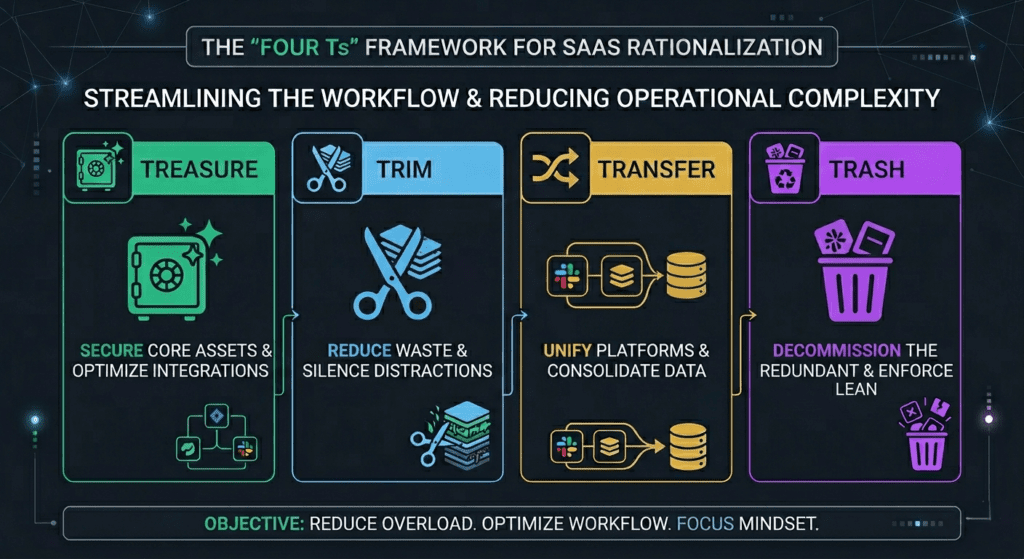
Phase 3: The four Ts rationalisation
To maintain a lean environment, teams should apply this framework to every application:
- Treasure: High-adoption tools that serve as a Single Source of Truth.
- Trim: Essential functions that suffer from redundant features or excessive licenses.
- Transfer: Merging two tools that serve the same purpose (e.g., consolidating design boards).
- Trash: Decommissioning apps with low usage or those rendered redundant by updates to core tools.
Distilled
As we move further into 2026, the mark of a sophisticated tech organisation won’t be how many tools it integrates, but how many it has the courage to retire. Implementing a “One-In, One-Out” policy ensures that for every new productivity hack added, an underperforming one is removed.
Productivity is broken because we have prioritised the speed of the tool over the focus of the human using it. The goal isn’t to find the next great app; it’s to find the discipline to turn the current ones off so we can actually get to work.