The New IP Architecture: Navigating AI Copyright in 2026


The legal bedrock of the creative industry hasn’t just shifted; it has fractured. For decades, intellectual property was a predictable, if complex, domain. As we navigate the complexities of AI copyright in 2026, we have fundamentally rewired the definition of authorship. Consequently, we have moved past the era of experimental prompts into a world where generative assets are the primary output of global marketing machines.
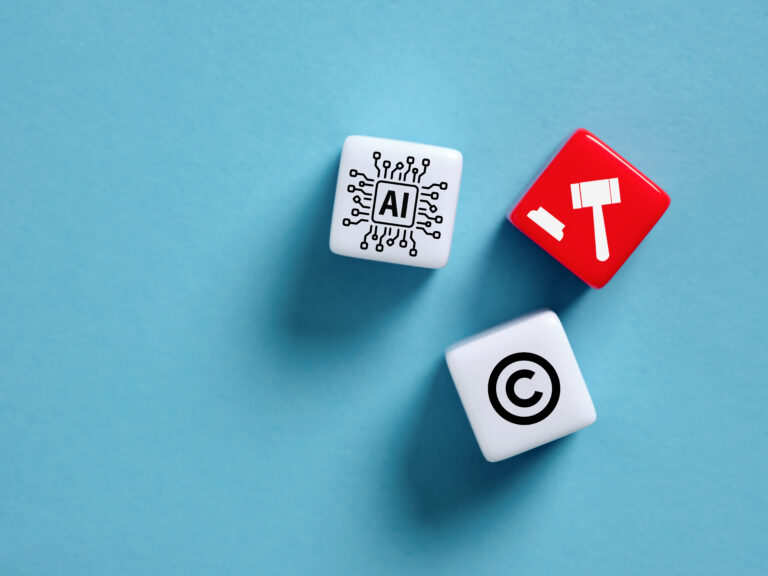
While there is no single AI Copyright Act on the books, the 2026 legal landscape is a high-stakes web of court rulings and regulatory guidance. The central tension of this new architecture isn’t just whether a machine can own a copyright, courts have firmly ruled no, but how human-led brands can legally capture the value of the machine’s labor. This transition has birthed the Clean Data Library (CDL): a strategic fortress designed to ensure creative responsibility while navigating the treacherous waters of modern litigation.
The death of the black box workflow
In early 2024, the industry operated on a don’t ask, don’t tell policy regarding training data. By 2026, that opacity will have become a terminal liability. Under the current AI copyright framework in 2026, the burden of proof has shifted from the plaintiff to the creator. If a brand cannot prove the provenance of the pixels or tokens in a campaign, it legally considers those assets public domain or, worse, infringing.
The new IP architecture demands a Chain of Custody for every generative asset. This involves three critical layers:
- The foundational layer: Public models with verified opt-out compliance.
- The refinement layer: Specialized models trained on internal, proprietary brand style guides.
- The human synthesis layer: The documented “substantial involvement” that bridges the gap between a machine-generated draft and a protected work.
The rise of clean data libraries
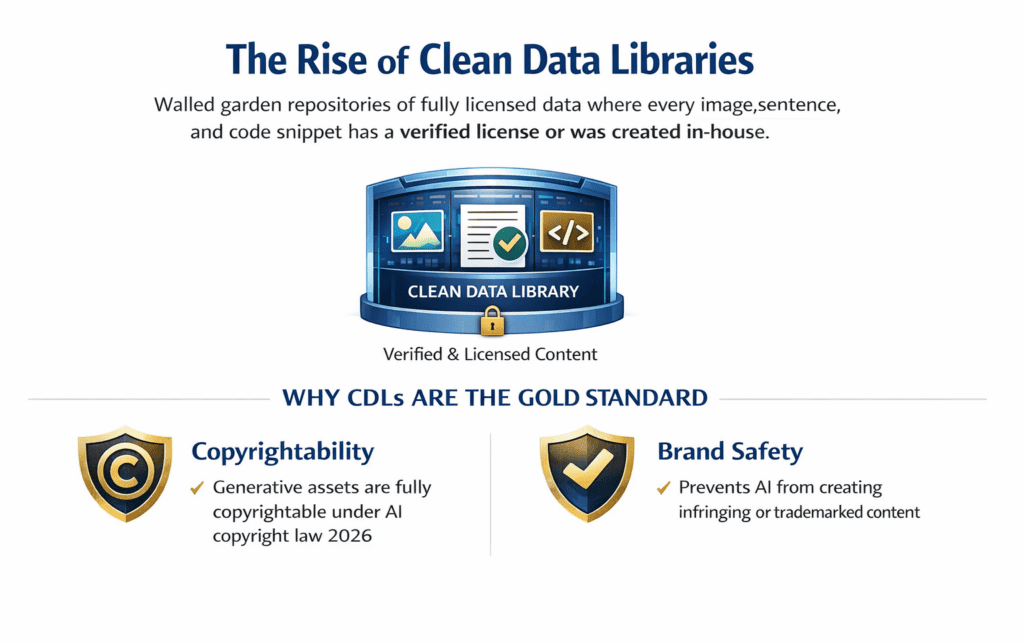
To survive this era, enterprise organizations are moving away from general-purpose scraped models. Instead, we are seeing the rise of Clean Data Libraries. A CDL serves as a sovereign repository where each image, sentence, and code snippet holds a verified license or is created in-house.
Why CDLs are the gold standard
By training walled garden models on these libraries, brands achieve two critical objectives:
- Enforceable protection: Because the AI is reflecting assets the brand already owns, the resulting outputs have a much stronger claim to protection under current AI copyright standards.
- Brand safety: It eliminates hallucinated infringement, where an AI accidentally reproduces a trademarked character or a copyrighted style it learned through unauthorized web scraping.
Digital ownership: From pixels to design intent
The most profound shift in ownership is the move from output-based rights to intent-based rights. In the past, you owned the thing you drew. Today, the legal argument is shifting toward Design Intent.
Modern legal teams are now archiving the Iterative Trail, which includes:
- Initial sketches and mood boards.
- The evolution of prompts (the prompt engineering logs).
- Manual edits and artistic choices were made to the AI’s output.
In the eyes of the Copyright Office, this trail is the Creative Signature required to secure a registration. You aren’t just owning an image; you are owning the specific, documented path of human decision-making that forced the AI to produce that specific result. This is a core pillar of AI copyright in 2026.
The violation spectrum: The new legal hazards
As brands adopt these technologies, the Violation Spectrum has become a checklist for corporate counsel. The risks are no longer just about direct copying; they are about statistical mimicry.
- Style infringement: While historically you couldn’t copyright a vibe, 2026 precedents suggest that fine-tuning a model specifically to mimic a living artist’s aesthetic without consent constitutes Commercial Identity Theft.
- Training data trespass: When a brand uses a third-party tool that claims to be “clean,” it may unknowingly utilise shadow data (unauthorised scrapes of paywalled sites). As a result, the brand becomes liable for downstream infringement, even if it lacks direct knowledge of the tool’s practices.
- The output overflow problem: This is a technical violation where an AI produces a result that is too close to a protected work. Without a CDL as a filter, brands are accidentally publishing Derivative Works that trigger automated takedowns.
The global compliance tracker: 2026 standards
Three major jurisdictions have set the de facto standards that technical leaders must follow for IP safety:
- United States (USCO): Maintains the Human Authorship Test. Works generated entirely by AI. Cannot be registered. Creators must disclose the use of AI and describe any manual selection, arrangement, or modification involved.
- European Union (EU AI Act): Focuses on The Transparency Mandate. Brands must clearly label AI-generated content and respect machine-readable opt-outs, making CDLs a functional necessity in the EU.
- China (Beijing Internet Court): Operates on Traceability of Effort. Copyright is possible, but authors must submit actual Generation Records (original prompts and iterative logs). Post-hoc simulations are rejected as evidence.
Infrastructure-layer enforcement
Technical leaders are adopting the solution of server-side sovereignty. This involves technical protocols that prevent AI crawlers from accessing proprietary content, essentially a digital “Do Not Disturb” sign at the code level. By combining these blocks with CDLs, companies are building a fortress around their IP, ensuring compliance with AI copyright in 2026.
Distilled
The 2026 IP mandate
The age of generative assets is no longer a legal frontier. It is, therefore, a highly regulated technical ecosystem where ownership is defined by the integrity of the process rather than the final file. Under current AI copyright standards in 2026, a significant Liability Flip has occurred. Placing the burden of proof for provenance squarely on the creator.
To secure enforceable rights, brands must move beyond simple outputs and focus on documenting the Creative Signature. The specific trail of human decisions, prompt iterations, and manual refinements that shaped the work. By using clean data libraries as the primary defense infrastructure, enterprise leaders can automate this compliance. Eliminating the risks of Shadow Data and ensuring that their generative assets remain protected, sovereign, and legally distinct.