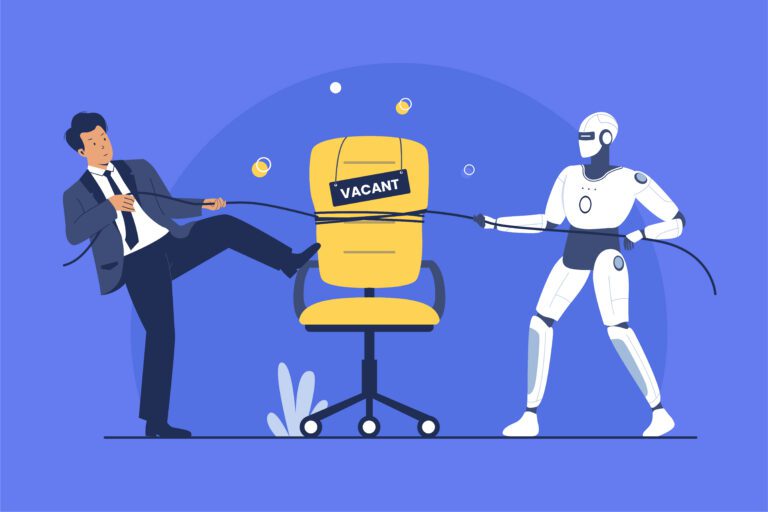
AI Impact on Entry-Level Jobs: Why Junior Roles Are Vanishing


The impact of AI on entry-level jobs is increasingly visible across the technology sector. Roles that once served as the first step into the workforce, such as data entry, basic support functions, and junior programming tasks, are shrinking as companies adopt automation and AI-assisted tools.
Entry-level positions traditionally allowed new graduates to learn systems, understand workflows, and develop technical judgement. Today, many of those routine tasks are being handled by software.
By 2024, entry-level hiring at several major technology firms had fallen sharply compared with the previous year. At the same time, employment among younger programmers declined significantly while senior developer roles remained relatively stable.
The pattern suggests that the AI’s impact on entry-level jobs is not simply about reducing headcount. It is changing how organisations structure their workforce and develop future talent.
Data entry: The first casualty
Automation has already reshaped one of the most common entry-level roles: data entry.
Organisations deploying AI-driven optical character recognition (OCR) and automated data pipelines have reduced data-entry staffing dramatically in recent years. These systems extract, classify, and validate information far faster than manual workflows.
In many organisations, large teams once responsible for processing documents have been replaced by much smaller groups that focus on exception handling—cases where automated systems require human judgement.
The transition rarely occurred through mass layoffs. Instead, companies gradually reduced hiring, declined to renew contractor roles, or left positions unfilled after employees left. Over time, the traditional entry path into administrative and operational work disappeared.
For many graduates seeking their first office roles, this shift represents one of the earliest examples of the AI impact on entry-level jobs.
Tier 1 support: Automation of routine requests
Customer support roles have experienced similar pressure.
Tasks such as password resets, billing inquiries, and basic troubleshooting once formed the foundation of Tier 1 support teams. Today, AI-powered chatbots and automated help systems resolve a large share of these requests.
Many organisations now rely on automation to manage routine queries while human agents focus on complex problems and escalation management.
As a result, Tier 1 support teams in some organisations have shrunk significantly. The change does not necessarily reflect poor performance by those employees. Rather, the work itself—scripted answers and repetitive troubleshooting—closely matches what AI systems handle most efficiently.
The trend highlights another dimension of the AI impact on entry-level jobs, particularly in service and operational roles.
Junior programmers: The unexpected target
Software development was once considered relatively protected from automation. However, AI coding assistants are beginning to change how development teams allocate work.
Research from Stanford indicates that employment among software developers in their early twenties declined noticeably between 2022 and 2025, while employment among older developers increased during the same period.
AI coding tools can now generate boilerplate code, fix common bugs, and build standard components quickly. These were traditionally the tasks assigned to junior developers as they learned the codebase.
Instead of replacing experienced engineers, AI tools often amplify their productivity. Senior developers can complete many tasks independently that previously required support from junior team members.
The result is fewer opportunities for new graduates to enter development teams and gain practical experience.
The career ladder problem
Entry-level roles historically served another purpose beyond productivity: they trained future talent.
Data entry roles taught employees how internal systems functioned and how to identify anomalies in workflows. Tier 1 support helped employees learn products deeply and understand customer behaviour. Junior programming roles allowed developers to learn through hands-on experimentation and code reviews.
When these entry points disappear, organisations risk weakening their talent pipeline.
Research from Harvard tracking tens of millions of workers found that junior employment declined significantly at companies adopting AI tools, while senior employment remained relatively stable. In the short term, companies reduced labour costs. In the long term, they risked losing the training ground for future mid-level and senior staff.
The experience inflation paradox
At the same time that junior roles are shrinking, job postings labelled “entry-level” increasingly demand prior experience. Across technology and IT fields, a large share of entry-level roles now request several years of experience. For new graduates, this creates a paradox: gaining experience requires a job, yet entry-level jobs increasingly expect candidates to already possess it.
The AI impact on entry-level jobs, therefore, extends beyond automation itself. It also reshapes hiring expectations and reduces opportunities for graduates to gain their first professional experience.
Who is still hiring
Not all sectors have reduced entry-level hiring equally. Healthcare organisations continue to hire junior staff because many roles require physical presence and regulated certification. Automation is more difficult in these environments.
Technology companies that continue to recruit early-career talent have also shifted their expectations. Roles in artificial intelligence and machine learning have grown rapidly, though many of these positions require specialised skills that are difficult to acquire without prior experience.
The traditional entry-level position where employees gradually learn on the job is becoming less common across the technology sector.
A future talent gap
Short-term efficiency gains from automation may create longer-term workforce challenges.
If companies reduce junior hiring for several consecutive years, the pool of mid-level engineers and specialists available later will shrink. Organisations could face skill shortages in the coming decade as experienced employees retire and fewer trained replacements exist.
In this sense, the AI impact on entry-level jobs may extend far beyond immediate hiring cycles. It could reshape how organisations train, develop, and retain technical talent.
Distilled
The AI impact on entry-level jobs is already visible across data entry, customer support, and junior development roles. Automation is replacing many routine tasks that once served as training grounds for early-career employees.
While these changes improve efficiency, they also remove important entry points into the workforce. Data entry teams have shrunk dramatically, Tier 1 support roles are increasingly automated, and junior programming positions are declining as AI tools expand the productivity of senior developers.
The long-term challenge is not simply job loss. It is the disappearance of the first step on the career ladder. If organisations do not find new ways to train and develop early-career talent alongside AI tools, the pipeline of future engineers and technical leaders may gradually dry up.