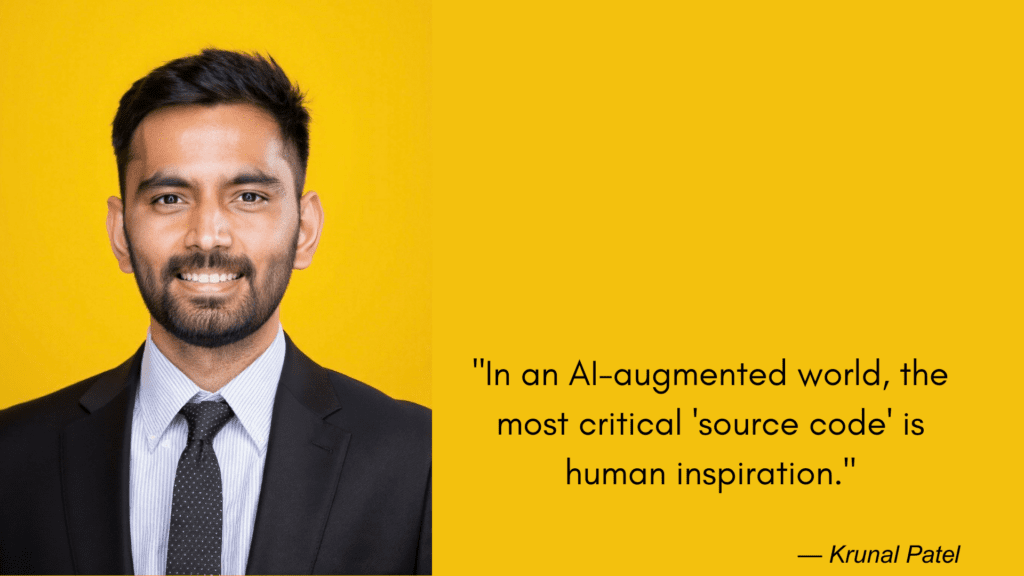
Krunal Patel on Transformational Leadership in the Age of AI


In conversation with the architect of AI-enabling hardware on the future of transformational leadership and redefining the Algorithm of Inspiration for a hybrid, agentic workforce.
In the high-stakes arena of global hardware, Krunal Patel operates at the source code of innovation. His career has been a masterclass in strategic impact and transformational leadership. Moving from the complex neural architectures of autonomous driving systems and the power-dense world of global gaming consoles to his current role at the foundation of the semiconductor industry. A $28B powerhouse that enables more than half of the world’s total chip production.
But as we enter 2026, Krunal envisions a challenge that goes beyond technical milestones or the next generation of dielectric deposition. He sees the true frontier as the Algorithm of Inspiration. As a member of the Forbes Technology Council and a Senior Member of IEEE, Krunal is pioneering a transformational leadership model. That balances the rigid, nanometer-scale precision of hardware manufacturing with the fluid, high-velocity needs of a hybrid, AI-augmented workforce.
In this exclusive Digital Digest feature, we sit down with Krunal to discuss why the future of leadership is no longer about monitoring output, but about managing intent.
The blueprint of transformational leadership
Your career has spanned vastly different ecosystems, from automotive and consumer electronics to semiconductor manufacturing. How has this journey shaped your definition of transformational leadership?
Krunal: The most unexpected thing I learned across the hardware industries is that the definition of a good decision is completely different depending on where we sit in the product development lifecycle. I discovered that the same program needs two opposing instincts at once. An extreme conservatism on the technical side and fast, clear decisions on the cross-functional side. My definition of transformational leadership is knowing which mode the situation calls for. Identifying system-level dependencies, assessing trade-offs, and quickly shifting between modes.
In a world where teams are now composed of both human talent and AI agents, how do you define the Human ROI in a technical program?
Krunal: Human ROI is defined by how well decisions are made. AI can optimise isolated tasks and improve efficiency in areas like requirements evaluation and software cycle reduction. But when it comes to complex hardware programs, where multiple teams, functions, and integrations must come together, AI is not yet capable of replacing human judgment. It can surface risks and provide greater visibility, but decision-making remains a human responsibility.
Influence without authority is a core tenet of technical program leadership. How does that skill evolve within a transformational leadership framework when the stakeholders you are influencing are increasingly automated workflows?
Krunal: In hardware programs, ambiguity is highest at the outset. As the program advances, costs, design locks, and cross-functional dependencies increase. To the point where change becomes significantly more expensive and difficult to reverse. In this setting, influence is reflected in the ability to drive critical decisions early, navigate execution through ambiguity, and bring future constraints into present decision-making before reaching irreversible commitment. Automation improves visibility, but it does not replace the experienced human judgment needed to resolve complex trade-offs.
From output to intent
You advocate for a shift from monitoring output to managing intent. For a program leader accustomed to rigid milestones, what does this look like in a practical, day-to-day sense?
Krunal: It means making sure everyone on the team understands why a milestone matters. When I run a change review, it’s good to explain the reasoning so the team can start making those calls themselves over time. That is the difference between a team that needs constant direction and one that can navigate on its own.
Large-scale hardware development requires extreme precision. How do you allow for the messiness of human creativity while maintaining the strict rigor of high-volume manufacturing (HVM) environments?
Krunal: Creativity must be encouraged early when ambiguity is high, and the cost of change is low. The key is not to eliminate that messiness. But to structure it, allowing flexibility during Proof-of-Concept phases while progressively introducing rigour as the design matures. As the program advances, variability is reduced, and processes are standardised. The goal is to let innovation improve the solution upfront while ensuring the design converges into the stability required for HVM.
With teams often spanning global time zones, Hybrid is a daily reality. What is one cultural algorithm you’ve developed to ensure a global team feels inspired rather than just tasked?
Krunal: I use a structured execution rhythm, decision, feedback, and risk cadences that create clarity across time zones so teams are aligned on outcomes, not just tasks. This ensures every team sees how their work connects to system-level impact. Thereby, turning distributed execution into shared ownership rather than isolated effort.
The hardware of humanity
You lead programs for technology that enable modern computing and AI chips. Does knowing that your hardware is the foundation for today’s AI change the way you mentor the humans building it?
Krunal: Yes. Knowing how all the dots connect shapes how teams operate. By helping them see the broader system impact and the big picture of their work, not just the task at hand.
Complex hardware development never sleeps. How do you prevent your team from hitting thermal throttling (burnout) in an era of constant connectivity?
Krunal: It is essential to make risks visible early. Through a living risk register that includes team capacity signals, not just technical risks. Combined with clear prioritisation, this ensures teams focus on what truly matters. Avoiding sustained overload and catching stress signals before they escalate.
Your background in Data Analytics shows high model accuracy. In leadership, however, we deal with noisy human data. When do you trust the dashboard, and when do you trust your intuition?
Krunal: We rely on data as the foundation. But important decisions, especially those involving trade-offs, require deeper due diligence beyond what dashboards show.
What is the biggest gap in hybrid leadership today that technology cannot fill?
Krunal: The biggest gap is at the interfaces, where teams, functions, and time zones intersect, and decisions stall. Technology can track work, but it cannot resolve cross-functional trade-offs or surface risks early enough to prevent cascade failures. That requires disciplined risk management and strong human judgment to align execution across the system.
Legacy & the next generation
Looking back at your early experiences building vehicles for engineering competitions, what did that from-scratch mentality teach you about leading programs in a global organization?
Krunal: Building anything from scratch teaches you to think in systems. Starting from a blank whiteboard, defining interactions through block diagrams, and understanding dependencies before jumping to solutions. In large organisations, that mindset helps me recognise the system-level integration needed to translate a playbook into a successful execution plan.
We are moving toward a workforce where AI handles execution, and humans handle ethics and empathy. How are you coaching your junior team members to thrive in this shift?
Krunal: One principle I consistently reinforce is that we must continuously evolve and learn how to learn. Adaptability is what will matter most as AI takes over more execution.
If you could program one mundane household chore to be perfectly handled by a robot today, which one would it be?
Krunal: Full-home cleaning is a strong example of how enclosure design, electronics, sensors, and machine learning come together in a real consumer product. It will only get better as AI makes these systems more adaptive. Eventually, humanoids powered by advanced semiconductors will handle this far more effectively. But that future depends on faster chip innovation to enable the real-time decision-making those systems need.