Planetary Geoscientist John Pereira II on Mapping the Moon’s Future


From the gemstone-rich landscapes of Brazil to Europe’s leading space research hubs, John Pereira II is helping shape humanity’s next giant leap. A planetary geoscientist with a background in terrestrial mining exploration, John is currently a Space Resources Exploration Geologist at the European Space Resources Innovation Centre (ESRIC) in Luxembourg. There, he supports the development of the Lunar Resources Reference Model (LRRM) — an ESA-funded initiative aimed at building a scientific and technical foundation for future lunar resource assessment.
Working at the intersection of field geology, geological modelling, geochemistry, geophysics, and GIS-based spatial analysis, John applies Earth-honed exploration techniques to prospective lunar terrains. His work includes geological interpretation, 3D modeling, and resource classification — critical steps in understanding where and how lunar resources may be accessed responsibly in the future.
In this exclusive interview with Digital Digest, John reflects on his global journey, his commitment to responsible exploration, and why the Moon may be humanity’s most important laboratory for the future of space resources.
Do you remember the moment geology “clicked” for you? Was there a place, rock, or person who sparked this passion?
John: Absolutely — like it was yesterday!
My mum worked as a school coordinator, and sometimes teachers gave her their teacher’s edition textbooks. Since those books were expensive, I reused them, but first I had to erase all the answers before classes started. While doing that, I often ended up reading the chapters out of curiosity.
One day, as I was erasing the answers in my science book, I started reading the first chapter. It was about the geological eras of Earth. The pictures immediately caught my attention, and the text explained how geology studies Earth’s formation, mountain building, and volcanoes. I remember thinking, “This is nice! I want to be a geologist!”
What’s funny is that even before that, I used to collect rocks I found on the streets without really knowing why. It never occurred to me that there was an entire science dedicated to understanding them as records of planetary processes.
My mum also has a theory that it might be “in my genes”. My aunt once wanted to study geology, and my grandfather worked in gold mining for a few years. I only found that out after deciding to pursue geology myself — though my mum still insists I would’ve made a good doctor!
Most geologists study our own planet. What made you look up and think, “Why not the moon?” What pulled you into planetary science?
John: Christopher Nolan! He’s the one to blame!
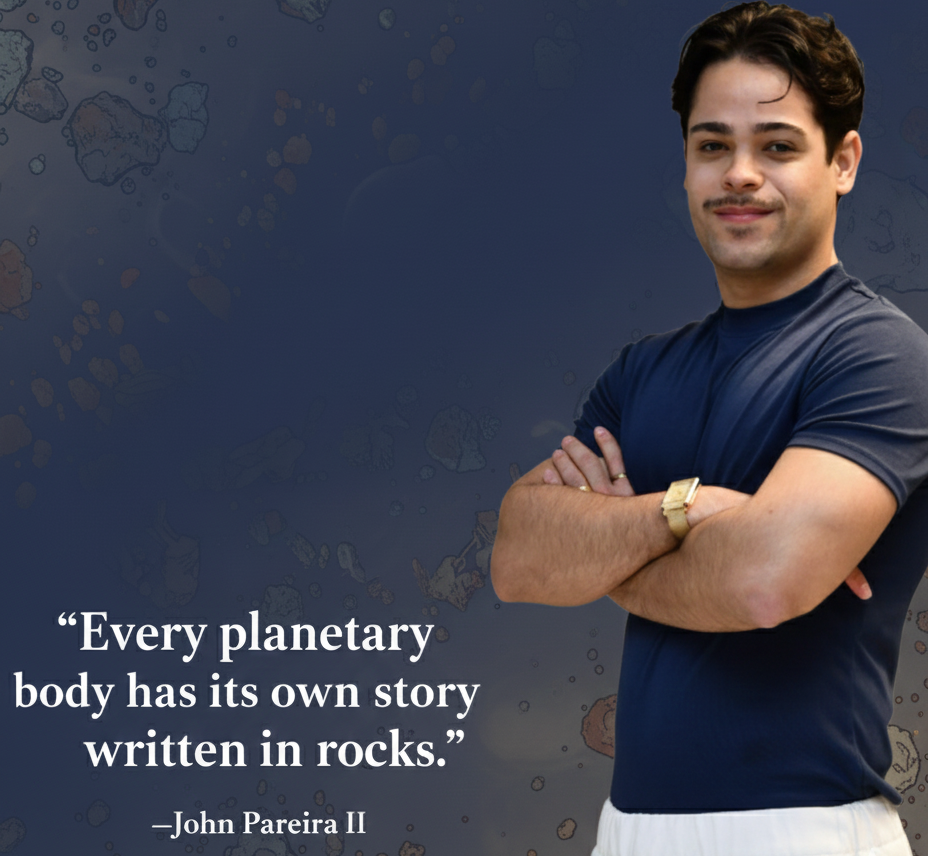
Of course, I’ve always found the universe fascinating, but it was after watching Interstellar that something really clicked. Just like Earth, every planetary body has its own story written in rocks.
Subscribe to our bi-weekly newsletter
Get the latest trends, insights, and strategies delivered straight to your inbox.
A few years ago, though, I had actually decided not to take my career into the planetary field. I found myself working in the mining and exploration industry, and I even had ideas about how to connect the terrestrial and space sectors, but at the time, I was convinced there wasn’t really a future in it.
Then I came across the GeoPlaNet Erasmus Mundus Joint Master, and I thought, “Okay, maybe this could be a great opportunity to give it a try.” During the interview for the programme, I was very clear: “I want to work with space mining.”
After a long search, I discovered ESRIC, and it felt like everything aligned — the right place, at the right time.
My plans were always connected to critical metals, not to a specific planetary body. The Moon was one of the options I considered, mainly because of its feasibility. It’s the closest body to Earth, and it acts like a natural laboratory where we can study processes that shaped not only its own surface, but also the early Earth.
You’ve lived and studied in Brazil, France, Portugal, Italy, and Luxembourg. How has this global path shaped your scientific outlook?
John: My former university in Brazil and my experience working on exploration projects definitely made me the geologist I am today — no doubt about that. My time in Europe gave me a solid entry into the world of planetary geosciences, and my experience at ESRIC was truly a game-changer.
But honestly, living across all these countries shaped me as a person even more than as a scientist. It taught me adaptability, open-mindedness, and how to collaborate with people from very different backgrounds. Now I see science as something global, built on shared knowledge and diverse perspectives.
When friends or family ask what you do, how do you explain “mapping lunar KREEP deposits” in a fun, simple way?
John: I really tried! We always joke that they’ll never understand what I actually do.
Among my friends, the usual explanation is just, “I’m looking for some rare metals on the Moon.” It’s simple, and it works. They even watched my thesis presentation online, and their reaction was, “We didn’t understand a single word, but it sounded fancy!”
As for my mum, she completely gave up trying to understand. Now she just says, “Just don’t go there!” She’s genuinely terrified by the idea that I could one day end up on the Moon.
A few months ago, I told her I’d been invited to join a project, and her first reaction was, “Oh God! You have to go to the Moon? You’re not crazy enough to do that, right?”
I even called her recently and asked what she would say if someone asked what I do. She’s been rehearsing: “He’s a geologist, with a Master’s in Planetary Geology, and he wants to mine the Moon.” I think she’s finally got the keywords right!
For you personally, is space mining about science, economics, sustainability, or humanity’s survival?
John: For me, the focus right now is much more on science and economics than on human survival. I don’t believe we should think about finding a “new home” in space before addressing the problems we’ve created here on Earth. Space shouldn’t be an escape plan.
Space resources could eventually help reduce pressure on Earth’s mining ecosystem, but that won’t happen soon, and it’s not the priority. Bringing materials back to Earth is also not the most realistic or immediate goal, at least for most potential resources.
The most feasible first step for space mining is ISRU (In-situ Resource Utilisation) — supporting missions, infrastructure, and long-term exploration, and eventually enabling the first human settlements.
At the same time, the terrestrial mining sector can benefit from technologies developed for space resources, helping make mining on Earth more efficient and sustainable.
Before any mining begins, thorough exploration and resource assessment are essential. This stage informs both scientific understanding and economic feasibility. On Earth, many projects fail because exploration wasn’t done properly, and we definitely don’t want to repeat that mistake in space, where risks and investments are much higher.
You’ve mapped lithium and gemstones on Earth. How does that field experience help when you’re interpreting satellite and rover data for the Moon?
John: “Geology is a science that gets inside you through your feet. There is no geologist without fieldwork.”
I heard this from my Metamorphic Petrology and Field Geology professor, one of my biggest mentors during my Bachelor’s.
You can read a thousand geology books and analyse millions of images on a computer, but without field experience, you can miss context and the intuition that only the field can give you.
In those projects, I worked at the forefront of geological mapping, both at the surface and subsurface. That experience helps me connect what I see in satellite imagery with what those patterns actually mean on the ground and at depth, mentally translating images into the physical 3D reality they represent.
Field geology gives you a kind of internal reference library — a sense for patterns, for clues, and for recognising when the data is telling a story worth following. Even on the Moon, where we can’t walk freely yet, that field intuition is essential.
What digital tools or advances excite you most in planetary exploration today?
John: As a field geologist, VR geological mapping, for sure.
It’s a powerful tool for training, mission planning, and terrain visualisation. However, there’s still a limitation — the resolution of most VR environments isn’t yet high enough for detailed geological mapping. At the moment, it’s more effective for broader geomorphological studies than for fine-scale geological interpretation.
How do you see AI changing the role of geologists?
John: I’m young, but I have an old-school geologist soul.
Until I started my Master’s, I had no experience with programming or AI, which I think is true for many geologists of my generation. That said, ignoring the efficiency of AI tools today wouldn’t be realistic — they really do speed up many processes. Still, I see AI as an ally, not a replacement.
I’ve even been told by non-geologists that my maps “could be done with AI.” What they don’t understand is that mapping relies heavily on methodology and geological reasoning, not just automation.
Nothing will replace fieldwork. Even when we use robots, geologists will still be needed to operate them, interpret the data, and make the key decisions. Technology is powerful, but geological judgement, reading terrain, integrating evidence, and recognising subtle features remain a human task.
Space mining may soon become a reality. What ethical principles should guide those first missions to ensure we don’t repeat Earth’s mistakes?
John: That’s such an important question. I think the first principles should be responsibility and sustainability. Resources may exist, but that doesn’t mean we should automatically extract them. Any exploration needs to be justified by a clear and reasonable purpose.
For ISRU, the priorities are the basic conditions that allow humans to live and work in space: oxygen, water, and energy. That’s why so much research focuses on extracting oxygen from the regolith, using Fe-Ti oxides like ilmenite or silicates, and on mapping and understanding water ice.
For me, ethics starts with asking why we’re doing this and making sure the goal is long-term sustainability, not extraction for its own sake.
Any mining activity, from exploration to extraction, causes environmental impact. For the Moon, we’ll need proper methodologies to evaluate both short- and long-term effects. Many people assume that because the Moon has no biological activity, there are no environmental risks — and that’s a very naïve way to look at it.
We also have centuries of mining experience on Earth, including lessons learned the hard way. This time, we have the chance to do better: minimise waste, plan carefully, and protect scientific and historical heritage sites.
Take helium-3, for example. It exists in extremely low concentrations in lunar regolith, meaning vast amounts of material would need to be processed to reach economic grades. That alone shows why we must think seriously about the environmental footprint of future lunar operations.
Finally, transparency and international collaboration are essential. Space belongs to no one, so decisions about its resources should involve open dialogue between nations, scientists, and industry. If we approach it with care, space mining can become a model for responsible resource management — in space and beyond.
What kind of leadership does a future in space resources require?
John: I don’t think there’s one specific type of leadership for this.
For sure, we’ll need leaders who can bring together different professionals and turn that into real synergy — and this doesn’t apply only to the space sector.
Personally, I’d love to see more geologists taking the lead in management roles, just as they often do in terrestrial mining projects. They understand both the science behind the resources and the practical aspects of exploration and extraction.
And this connects to something really important for the coming years: we will need to find ways to encourage more geologists to move into the space resources field. Their experience is essential. Bridging Earth-based exploration with off-Earth exploration will be key to building a solid and sustainable space resources industry.
What keeps you motivated when research feels slow or uncertain?
John: I’m very result-oriented. What motivates me is knowing that every step brings me closer to an answer.
Even a “negative” result is still progress in the bigger picture I’m trying to build. It took time for me to accept unexpected outcomes, and I’m still learning, but it’s part of the process.
Most of the time, I’m doing things I genuinely enjoy. Even when a task isn’t my favourite, remote sensing image processing, for example, it still serves a larger goal. That’s my fuel.
What would you tell a 15-year-old dreaming of a career like yours?
John: First, try to understand what you really want to do, and accept that it will change. That’s completely normal. Let those changes guide you, not scare you.
Take risks. Be ambitious. Ambition isn’t negative as long as you respect others and yourself. Learning to recognise and respect my own limits has been one of the most important parts of my journey.
Where do you hope to be in 10 years?
John: I want to bridge the terrestrial and space sectors in a more efficient and practical way.
Right now, my focus is on understanding the space industry’s needs, meeting people, and learning how and when to put these ideas into practice. The Lunar Resources Reference Model is my main focus at the moment, and this is only the first stage.
I know where I want to go, but I’ll embrace the challenges along the way; every one of them is a brick in the wall I’m building.
Paint us a picture: in your imagination, what will the first real human settlement on the Moon feel like?
John: I hope it looks very different from the grey, igloo-like structures we often see in concept art. I imagine a place that feels human — creative, warm, and alive. A “new world” shouldn’t be only functional; it should also be visually welcoming and full of colour.
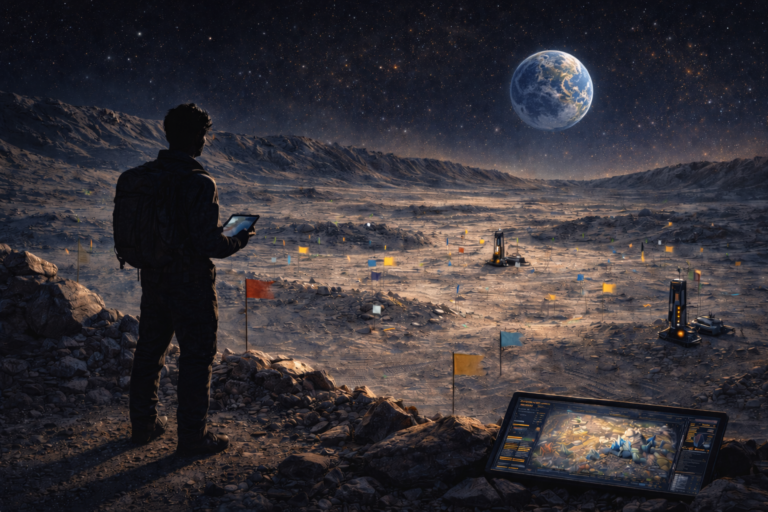
I picture solar panels spread across the surface, modules with warm lighting, and robots and rovers constantly moving around. We, geologists, are heading out in lunar vehicles to conduct fieldwork, accompanied by a robotic assistant. Okay, maybe that’s a bit too much Interstellar, but it would be nice.
Inside the habitats and labs, I imagine small green spaces and places to pause and breathe. And when we look out of the window, we would see Earth — bright, blue, and beautiful.
And honestly, I hope we still have Netflix and Instagram. I’m chronically online, and I’m not sure I’d survive without my movies and the occasional memes — as a good Brazilian!