Antonio Stark: The Space Strategist Shaping a Shared Future Beyond Earth


In conversation with a global space visionary, explorer, and educator helping chart humanity’s next chapter beyond Earth.
Making of a Modern Explorer
From Arctic ice fields to Himalayan summits, from analog missions to lunar missions, Antonio Stark is one of the rare figures in the space sector who seems to exist everywhere at once. A global space strategy and policy expert, he has worked across satellites, lunar missions, military diplomacy, sustainability innovation, AI research, youth space education, and international space cooperation, all while becoming a recognisable voice on the global stage.
Digital Digest sits down with the man many affectionately call the real-life Tony Stark of the lunar era. In this conversation, we explore how he sees the future of space tech, what it will take for humans to live beyond Earth, the rise of private space ecosystems, the truth about AI in orbit, and how the next generation can claim their place in the cosmos from someone helping to shape it.
Origins and Inspiration
We look at the Moon every day, familiar yet distant. What first drew you toward space, and how did that evolve into becoming a leading voice in today’s lunar era?
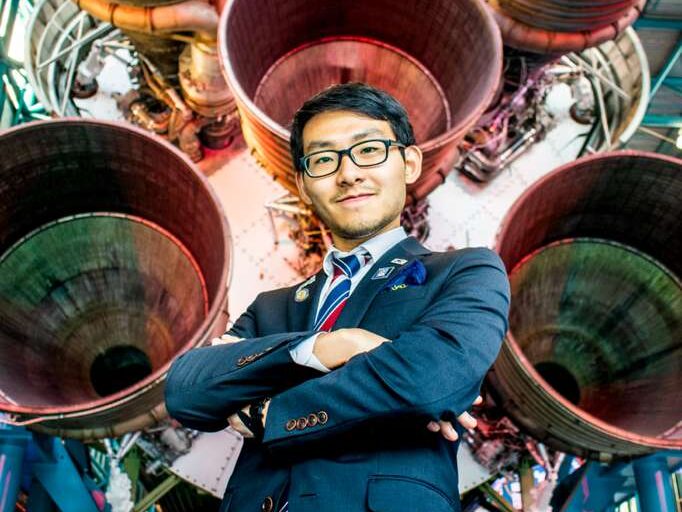
Stark: Space has always been a life calling. I knew early on that I wanted to work beyond Earth. People often assume the Moon was my original focus, but I actually began with satellites — my first job in the sector was to work on Earth observation constellations at Planet, and later NEI (Non-Earth Imaging) capabilities at HEO. My move into lunar missions wasn’t planned; it grew naturally from the roles I took on. Over time, I shaped my identity around global space strategy and policy because that’s the thread connecting everything I do: technology, diplomacy, exploration, and systems thinking across the sector.
Your journey spans AI, sustainability, UN programmes, expeditions, teaching, youth engagement, and even military diplomacy. Did you always envision such an unconventional path into the space sector?
Stark: My university degree was in AI and machine learning, so a lot of my early projects were actually on intelligent systems rather than spacecraft. I also had a three-year career in the Korean Marine Corps as a lieutenant after completing Officer Candidate School. Those three years also left an impression on me, where I got to work with military diplomacy among allied nations.
Before I began full-time in the space sector, I used to run a sustainability-focused startup accelerator in Norway. The timing was ideal, as the UN SDGs had just been announced, and we proved that there could be an entire market segment for startups selling solutions around sustainability. The work we did attracted more than 10,000 participants and applicants around the world, and we were later chosen as one of the Norwegian Torchbearers for the PyeongChang Olympics. None of these experiences looked like a direct route into space at the time, but together they shaped the perspective and flexibility I bring to the sector today.
Pivotal Moments and Extreme Environments
Was there a defining moment that shifted how you saw your place in the space industry and what felt possible for you?
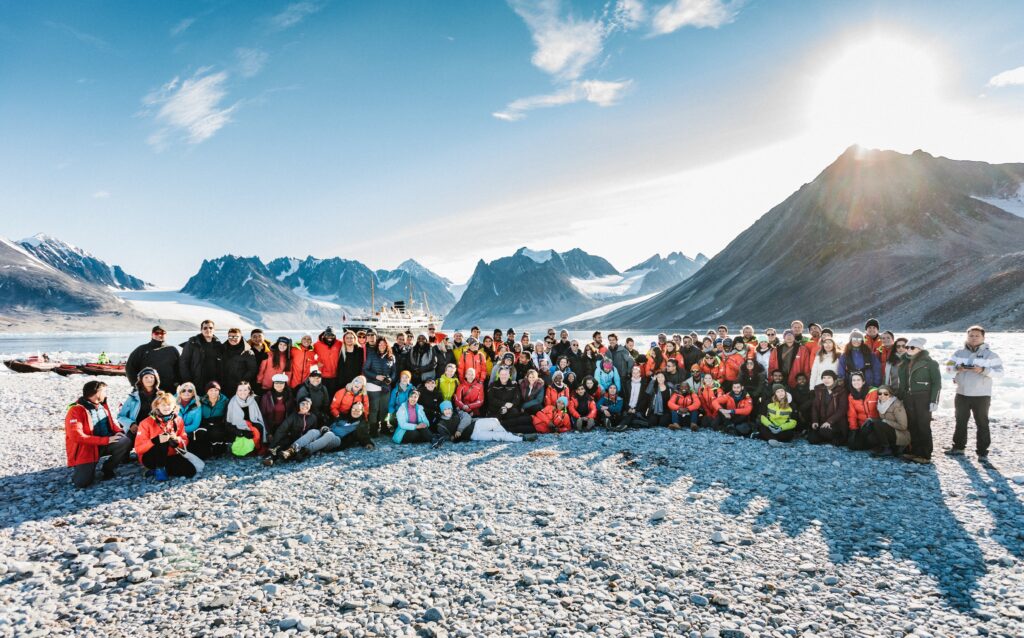
Stark: While there were numerous experiences that I’m extremely grateful for, being part of the FutureTalks Foundation’s 100 world leaders to the Arctic was a highlight like none other. The expedition consisted mostly of World Economic Forum YGLs who were VPs of social media companies, world-leading architects, CEOs of entire cities, and even the producer of Westworld. The organizers wanted to include select young participants to the crew, and I was so lucky to be one of those few. It was truly a transformative experience to be surrounded by the greatest decision-makers in the world, offline to the world in the middle of the Arctic Ocean, and talking about the biggest problems facing the world. That experience shaped my worldview even before the rest of my career unfolded.
You’ve trained and operated in extreme environments, from Arctic expeditions and Himalayan treks to cold-water technical dives, lava tube rover testing, and analog astronaut missions. How have these experiences shaped your perspective on off-world living?
Stark: Constantly moving around and adapting to new environments taught me as much as going to “adventure” destinations around the world. Japan is now the 10th country I’ve lived in, and it taught me about the diversity of human perspectives and how they can add immeasurable value to our thoughts. My expeditions to the Arctic, Himalayas, scuba diving in –20°C waters in Iceland or in Patagonian glacial lakes were just taking that to a new level. It taught me both the value of new perspectives and the resilience of the human spirit.
I think I come closest to these realisations when I’m out there teaching a group of students, which I did at an International Space University program in Korea, and to Scouts and Girl Guides in the Maldives. There, I saw that I can connect them to dream about the stars in ways that are rare for most. I can show them that all our engineering innovation, entrepreneurial spirit, and willingness to persevere can bring us together to find new frontiers in outer space: it’s about human capability, psychology, and endurance.
AI, Technology, and Innovation
Coming from an AI and machine-learning background, how do you see intelligent systems realistically contributing to lunar missions and space operations in the decade ahead?
Stark: AI will have a major impact, but the term is used far too loosely. The space sector now doesn’t much need the generative AI that is moderately good at most tasks, but highly specialised systems that excel at narrow, mission-critical tasks in a short timeframe. We simply don’t have the data or computing power to execute such machine learning beyond Earth.
Subscribe to our bi-weekly newsletter
Get the latest trends, insights, and strategies delivered straight to your inbox.
When I worked at Planet, I learned that we process up to 30 terabytes of satellite imagery every day. That volume is what enables us to train models, identify objects, and extract intelligence. Space missions don’t yet have that scale. In orbit or on the Moon, reliability matters more than creativity. Even Starlink uses sophisticated algorithms to deconflict satellites, but these are more akin to advanced algorithms than those used by ChatGPT. There will come a time when generative AGI will support entire communities living off-world – but right now, I think we need to focus more on biases in our datasets, the accountability of AI-driven decision-making processes, and the niche areas in which specialized AIs can make groundbreaking progress for specific objectives.
Space technology is advancing rapidly, with developments that once felt like science fiction. Which emerging innovations excite you most right now?
Stark: More than a specific technology, I think the startup-driven technological advancement is most striking. There’s a widely held belief that innovation progresses at exponential speeds marked by Moore’s Law. I think such speeds can’t be possible without startups competing in an open market ecosystem, which enabled mega-constellations, satellites operating in very low Earth orbit, air-breathing spacecraft, optical laser links, and edge computing in orbit. These ideas were deemed impractical not long ago, and now they’re being prototyped or deployed.
Of course, the sector still resembles a bubble, but that’s how innovation works. Venture capital firms usually need only a handful of starstruck successes across their portfolios, and those outliers can shift an entire industry. That dynamic is propelling space technology forward at a remarkable pace.
Sustainability, Ethics, and Policy
With increasing launches, mega-constellations, and new entrants, space is becoming crowded. What does sustainability look like in this context, and how can the sector protect long-term access?
Stark: Sustainability has layers. One part is physical, reducing orbital debris so future generations have usable space. Another is access, ensuring emerging nations still have room to participate. Sustainability isn’t only about cleaning up; it’s about preventing exclusion and making sure the sector doesn’t collapse under its own congestion.
Global cooperation in space comes with competing policies, interests, and power dynamics. How do you see ethics and collaboration evolving as more nations and companies enter the space domain?
Stark: It won’t be perfectly ethical; nothing in history has been. Power protects power. What matters is how the public and private sectors balance each other. The strongest ecosystems blend both, creating stability, capability, and innovation. It’s less about morality and more about maintaining a workable balance.

The New Space Economy and Future Talent
The private space sector has expanded dramatically. What do you believe has driven this surge, and how do you see the balance between public and private shaping the future?
Stark: Part of the surge is branding: space became cool, and NASA evolved into a pop-culture icon. Many companies have been building space technology quietly for years, and now they’re stepping into the spotlight. Venture capital also needed “cool” investments at a time when space made little economic sense. It used to be a joke that the fastest way to become a millionaire in space was to start as a billionaire. However, there is now genuine commercial momentum, even though much of the sector still relies on government programs.
You’ve taught, mentored, and worked closely with emerging space communities. What guidance would you share with young people hoping to build a career in space today?
Stark: When I started my space journey, my biggest challenge was finding enough information about space. Today, the challenge is the opposite — there’s too much information. The real skill is filtering, focusing, and doing meaningful projects. If you try everything, you burn out and never develop depth. Influencers make space exciting, but consuming content doesn’t make you unique. You need your own angle and something tangible to show for it.
Looking ahead, is there a personal dream or milestone that once felt out of reach, but now feels closer than ever?
Stark: I’ve always wanted to be an astronaut, and that ambition hasn’t faded with time—it has only become clearer. I don’t want to go to space as a passenger, but as a crew member with a role, a purpose, and a responsibility to advance science for all humankind. I still don’t know which route will take me there, but the landscape has changed. There are more pathways now than ever, and that makes the dream feel closer, not further away.
Identity and Personal Journey
And to end on a fun note, people love calling you the real-life Tony Stark of the lunar era. With your real name being Kangsan Kim, how did “Antonio Stark” come to be, and how did it end up following you into the space world?
Stark: I wanted a name with meaning—something that would stay with me. “Stark” came from the idea of a Star, symbolising a guiding point or North Star, and “K,” my initials. “Antonio” was inspired by Antoni Gaudí, because I once imagined becoming an architect, perhaps even a space architect. I created this identity before Iron Man ever appeared on screen, so the coincidence still amuses me—but I certainly don’t mind the comparison now.