
Bfore.Ai: Product of the Quarter Redefining Enterprise Defense


Imagine sitting in a corporate Security Operations Center (SOC) at 2:00 AM. Monitors suddenly flash amber, then deep red. A firewall drops a malicious packet. A security analyst frantically isolates a workstation. The incident response playbook kicks in, the containment succeeds, and the morning shift logs it as a victory. But let’s look at the brutal reality behind that win: if you are blocking an attack that has already knocked on your door, your strategy for enterprise defense is already operating at a massive disadvantage.
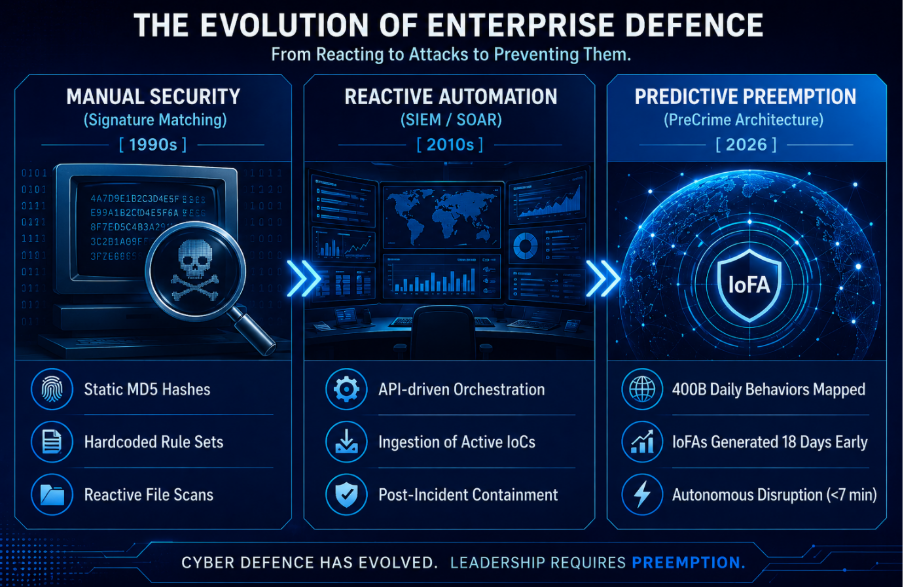
By the time traditional security tools trigger an alert, the adversary has already bought the domains, mapped your subnets, generated their spoofed SSL certificates, and weaponized their infrastructure. The industry calls this operating right of boom, frantically cleaning up a disaster that has already started.
Digital Digest has crowned Bfore.Ai and its PreCrime™ platform as our Product of the Quarter (Q2) because it shifts the entire paradigm of reactionary coverage, and establishes a baseline of predictive enterprise defense. Instead of reacting, Bfore.Ai treats global internet infrastructure as a predictable, evolving behavioral matrix. It maps out where digital weapons are actively being forged and neutralizes them an average of 18 days before the first phase of an attack campaign ever launches.
The brains of the insurance-backed blueprint
The architecture of Bfore.Ai was built to solve a specific, systemic flaw: human abuse desks and traditional automated filters simply cannot scale against the breakneck velocity of AI-driven brand impersonation and infrastructure staging. The deep-tech startup was built by a trio of European and Argentinian founders who brought a highly practical, data-first philosophy to modern enterprise defense:
- Luigi Lenguito (Co-Founder & CEO): A former Formula 3 racing driver turned tech executive (with deep roots scaling global operations at Dell). Lenguito brought a high-stakes question to cybersecurity: Why can’t we bring the concept of predictive “Pre-Crime” to network architecture? He realized that the only way to beat cybercriminals was to completely destroy the economic upside of setting up their digital infrastructure.
- Luciano Allegro (Co-Founder & Chief Automation Officer): The core mind behind the platform’s predictive machine learning classifiers. Allegro abandoned the heavy, laggy approach of analyzing raw code payloads or scanning content. Instead, he designed a lean engine that tracks the behavioral footprints of internet infrastructure as it is being registered and routed.
- Sebastian Cesario (Co-Founder & CTO): The operations architect who engineered the platform to withstand massive global event spikes (such as major elections or international sports tournaments) when malicious lookalike domains and rogue hosting spikes scale exponentially.
The team anchored their tech with an industry first: a contractual PreCrime™ Guarantee backed by global insurance giant Munich Re. If their predictive engine fails to preempt an attack and an organization suffers a breach, the program pays back up to 10 times the annual service contract value (with options scaling to 50x). It isn’t just a marketing line; it’s an absolute commitment to structural accuracy.
Infrastructure telemetry at scale
Bfore.Ai does not monitor your internal corporate email or track employee devices. Instead, its cloud-native backend maps over 98% of the global internet, tracking more than 500 million domains and processing up to 400 billion behavioral data points daily through its graph database.
The engine targets the logistical chokepoints that every attacker is forced to use when staging an exploit to deliver automated, actionable intelligence to your enterprise defense grid before an intrusion can occur:
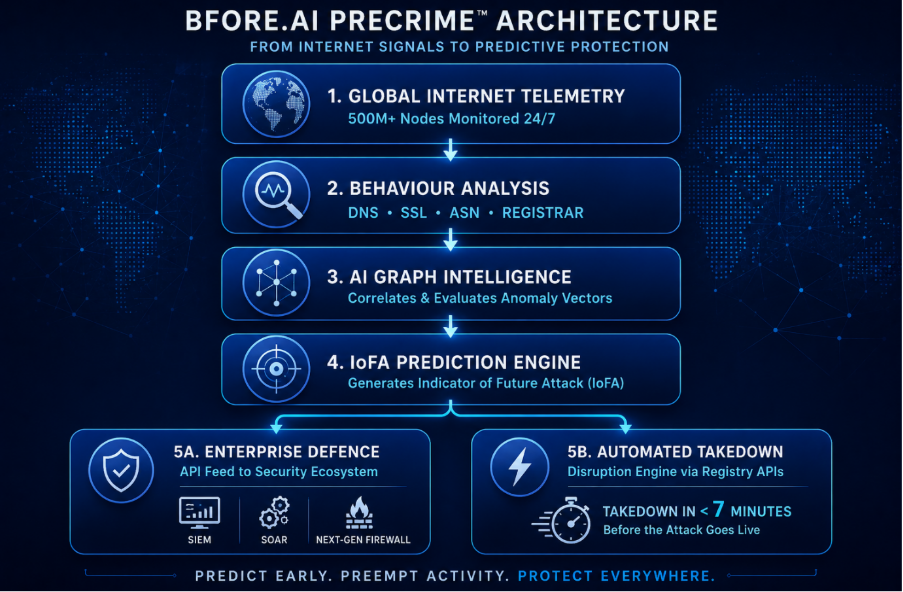
- DNS core mutability: Spotting fast-flux DNS shifts and erratic Time-to-Live (TTL) configurations designed to rapidly shuffle IP addresses and obscure a command-and-control (C2) server.
- Registrar footprints: Identifying bulk, programmatic domain registrations that mirror the behavior of known threat actors, including the use of specific privacy proxies and suspicious payment patterns.
- BGP and ASN clustering: Analyzing Autonomous System Number (ASN) reputations to notice when newly purchased domains are quietly parked on hosting neighborhoods directly adjacent to active cybercrime rings.
- SSL/TLS certificate telescoping: Catching the exact second an automated Transport Layer Security (TLS) certificate is issued to a dormant, un-activated domain that uses subtle typosquatting (lookalike spelling) of a protected corporate brand.
When these features are analyzed, the engine runs a predictive graph calculation:

If the score crosses a strict mathematical threshold, the system flags an alert with 99.95% precision and near-zero false positives (<0.05%). The threat is isolated while it is still a blank page sitting quietly on a remote server.
The competitive landscape: How PreCrime compares
To understand why this solution is a dark horse taking the internet by storm, we have to evaluate how it compares to legacy tech paradigms. Bfore.Ai fundamentally changes the defensive model by establishing preemptive infrastructure monitoring as the new baseline for enterprise defense:
| Evaluative Vectors | Legacy Threat Feeds (e.g., ThreatConnect, CrowdStrike) | External Attack Surface Management (EASM) (e.g., CyCognito) | Bfore.Ai PreCrime Platform |
|---|---|---|---|
| Primary Focus | Aggregating known Indicators of Compromise (IoCs). | Cataloging and auditing your own external-facing IT assets. | Mapping adversary infrastructure intent and isolating rogue nodes. |
| Temporal Horizon | Reactive: Logs file hashes and bad IPs after they hit someone else. | Static/Current: Audits what your enterprise owns right now. | Predictive: Forecasts malicious infrastructure 18 days early. |
| Actionable Window | Hours to weeks after global compromise events are recorded. | Continuous or scheduled discovery sweeps of your network perimeter. | Under 7 minutes from structural detection to active ecosystem block. |
| Core Architecture | Heavy reliance on payload analysis and signature matching. | Network pings, port scanning, and asset discovery. | Agentless, API-first behavioral network graph analysis. |
Real-world proof: The Big tech ecosystem & enterprise case studies
Bfore.Ai has quietly validated its technology through high-level integration with the Google for Startups Growth Academy. AI for Cybersecurity and the Microsoft Pegasus Program, building active threat-sharing pipelines into the foundations of big tech:
- The Microsoft sentinel native hook: Bfore.Ai serves as a plug-and-play integration directly within the Azure Storefront. It populates Microsoft Sentinel SIEMs with over 100,000 proactive threat vectors daily using standard STIX/TAXII protocols. Thereby, allowing corporate security teams to configure out-of-the-box correlation rules in minutes.
- The banking substrate (The Volksbank case): Volksbank, a leading retail financial institution, was drowning in targeted brand-jacking and infrastructure-spoofing campaigns. Within just 15 days of deploying Bfore.Ai’s predictive layer, the system preemptively mapped and forced the automated takedown of over 20 dormant, lookalike phishing infrastructures. The result? An immediate $800,000 saved in direct fraud and incident response losses before a single customer received a malicious link.
- Autonomous attack mitigation at scale: Through its vast disruption partner ecosystem, Bfore.Ai passes its live feed to core DNS resolvers and firewalls. The moment a domain turns malicious, Bfore.Ai triggers an active block in under 7 minutes, completing 93% of takedowns before any content presents itself on the site.
Step-by-step usage & integration guide
Because the entire platform is agentless and API-first. You don’t need to deploy endpoints, configure on-prem servers, or touch local kernel drivers. Shifting your network strategy toward proactive enterprise defense follows a clean, four-stage integration workflow:
Step 1: Asset provisioning and tenant creation
Log into the secure cloud tenant to generate rollable, cryptographic API keys. For immediate brand safety and infrastructure protection, input your organization’s primary domain portfolios. Along with trademark keyword strings and high-value brand identities to ground the contextual monitoring engine.
Step 2: API integration and ingestion mapping
Configure your internal SIEM or SOAR platform to accept the external TAXII feed. Map the incoming STIX 2.1 JSON schemas so that Bfore.Ai’s unique infrastructure tracking data routes directly into your local threat logging tables.
Step 3: Threshold alignment and policy calibration
Establish your automated enforcement rules. Set the system to ingest only high-confidence indicators (>99.95%) to maintain the platform’s guaranteed low false-positive rate (0.05%). Run the infrastructure in “Log Only” mode for an initial 72-hour validation window to review cross-telemetry performance.
Step 4: Orchestration rule activation
Transition the system from logging to active preemption. Connect your automated SOAR playbooks directly to your edge infrastructure (e.g., Palo Alto Networks firewalls or Zscaler gateways). The perimeter will now automatically inject these predicted threat profiles into rolling, short-term blocklists. Thereby, dropping malicious packets at your network boundary before they can make contact with an internal asset.
Future horizons: Defending against the agentic wave
As we look toward the horizon, the nature of enterprise threats is shifting drastically. Adversaries are no longer manually typing out phishing attacks or deploying static malware lines. They are launching autonomous, LLM-driven agentic attack strings. These rogue AI agents can register a domain. Spin up hosting, and generate an entirely unique, context-aware spear-phishing payload within a matter of minutes.
In an ecosystem where threats morph at machine speed, human-led abuse responses or reactive signature matching are structurally obsolete.
Bfore.Ai is positioning itself as the foundational defensive smart layer for this AI-vs-AI battleground. Because the PreCrime engine targets the logistical reality of the internet. The undeniable fact that any malicious agent, human or AI, must buy infrastructure. Then, establish DNS pathways, and request cryptographic certificates, it completely bypasses the payload guessing game. By evolving their technology to feed real-time indicators directly into emerging Zero Trust Architectures (ZTA) and Secure Access Service Edge (SASE) systems, Bfore.Ai is building an internet where malicious intent is structurally neutralized long before it can even type its first prompt.
Bfore.Ai changes the fundamental economics of cyber defense. By moving cybersecurity past the crowded, exhausting market of payload detection and transforming it into a precise data science problem of infrastructure preemption, it delivers a masterclass in clean signal over noise. Modern enterprise defense doesn’t ask you to respond faster to a crisis; it ensures the crisis is completely avoided.